
DR CHARLES ALFRED MOODY
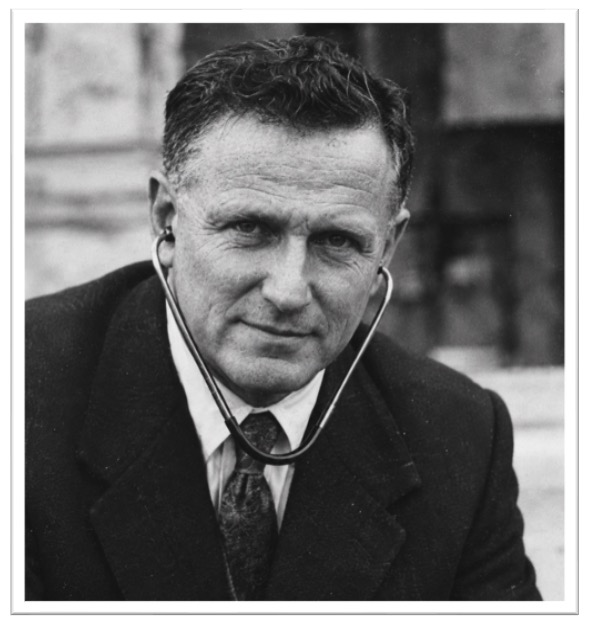
Cover Photo and Disclaimer
From his medical practice and pioneering youth work at Grange to his later missionary service in the Pacific and Papua, Dr Charles Alfred Moody led a remarkable life shaped by Christian faith, community service and a spirit of adventure.
The photo of Dr Moody above has been AI-generated from an authentic photograph taken at the Lady Hore-Ruthven Children’s Home in 1946 and as such may not be an accurate representatation of his appearance.
Original photograph: National Library of Australia, Trove.
Disclaimer:
This article is based on available historical evidence. Information has been drawn from material held in the Henley & Grange Historical Society Collection together with external websites, newspapers, published works, and academic research. Some sources reflect the recollections and interpretations of their authors and while every reasonable effort has been made to verify this information against primary sources and ensure historical accuracy, the Henley & Grange Historical Society cannot guarantee that all content is complete, accurate, or free from error. Images and other media have been used under Creative Commons licences, are in the public domain, or have been reproduced with permission and appropriate attribution to the copyright holder. This article is intended solely for historical, research and educational purposes. No offence to any person, living or deceased, is intended.
EARLY LIFE
Charles Alfred Moody was born in Portsmouth, England in August 1900.[1]
From an early age he developed a strong Christian faith, an influence that would remain central throughout his entire life. He went on to study medicine at St. Bartholomew’s Hospital Medical School in London, where he was a student from 1917.[2]
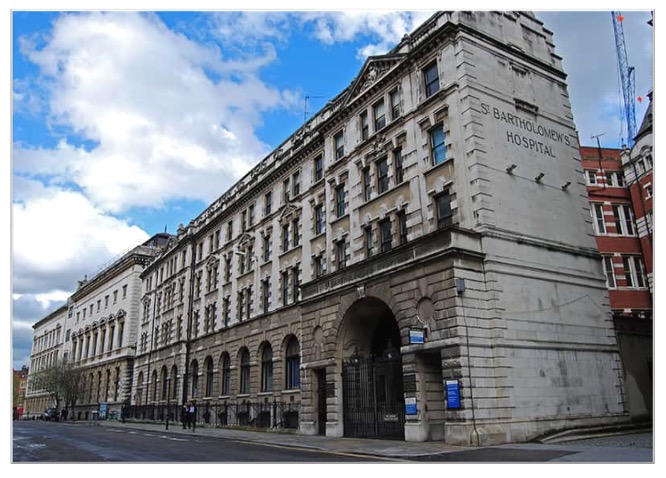 St. Bartholomew’s Hospital [3]
Charles qualified as a doctor in 1925, gaining the prestigious Member of the Royal College of Surgeons of England (MRCS) and the Licentiate of the Royal College of Physicians of London (LRCP) qualifications, however rather than settling into an ordinary medical practice, his strong religious convictions led him towards missionary medicine.[4]
He first worked with the North Sea fishing fleet missionary service providing medical, practical, and spiritual support to fishermen working in dangerous offshore waters, then later as a medical missionary in the Belgian Congo, both settings being very different environments from the one in which he had trained.
He returned to England in 1929 and married Jean Christian McLaurin Maddox, in September 1938.[5] Jean was the youngest daughter of Dr. Ernest Edmond Maddox (a highly prominent ophthalmic surgeon and medical author) and Grace Rivers Monteath. Growing up in a medical household likely connected Jean to Charles during his medical training in London.[6]
Footnotes:
[1] Ancestry.com.au
[2] Medical Students of St Bartholomew’s Hospital Medical School 1842/1935 https://www.qmul.ac.uk/fmd/media/smd/archives/SBHMS-S-6-2-spreadsheet—alphabetical.pdf
[3] Frenger Systems https://www.frenger.co.uk
[4] Queen Mary University of London Library https://www.qmul.ac.uk/
[5] Free UK Genealogy https://www.freebmd.org.uk/cgi/information.pl?cite=Wt4pc%2BK8M5nP3iVXbbc%2Bcw&scan=1
[6] Ryland Family Tree https://ryeland.com/getperson.php?personID=I8300&tree=Ryeland
COMING TO GRANGE
Following his marriage in 1938, Charles worked as a missionary in Cape Town, South Africa, with Jean, sister Irene and mother, Sophia.
Whether this was a formal missionary appointment, a temporary period of medical or missionary work, or a transition between overseas assignments remains to be established, however, almost a year after arriving in Cape Town they all boarded the S.S.Dominion Monarch and migrated to Australia, arriving in Fremantle at 7.00am on the 2nd of September 1939. The ship then sailed again at about 3:10 pm the same day reaching Melbourne on the Melbourne on the 7th of September.
The Moody’s disembarked in Melbourne.
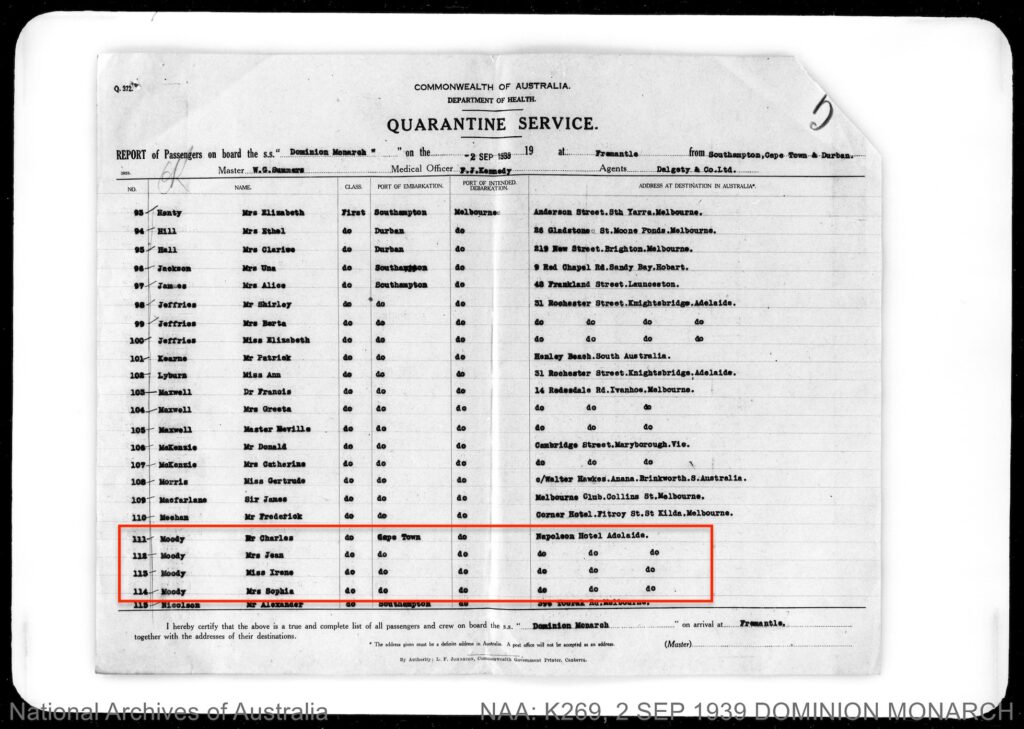
Quarantine Service Record Incoming Passengers from the S.S.Dominion Monarch [7]
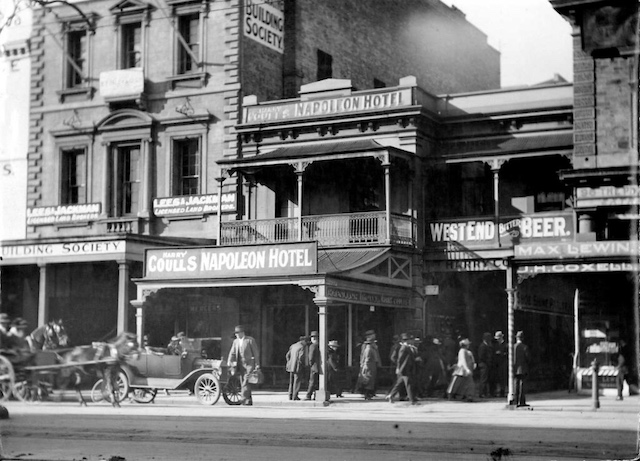
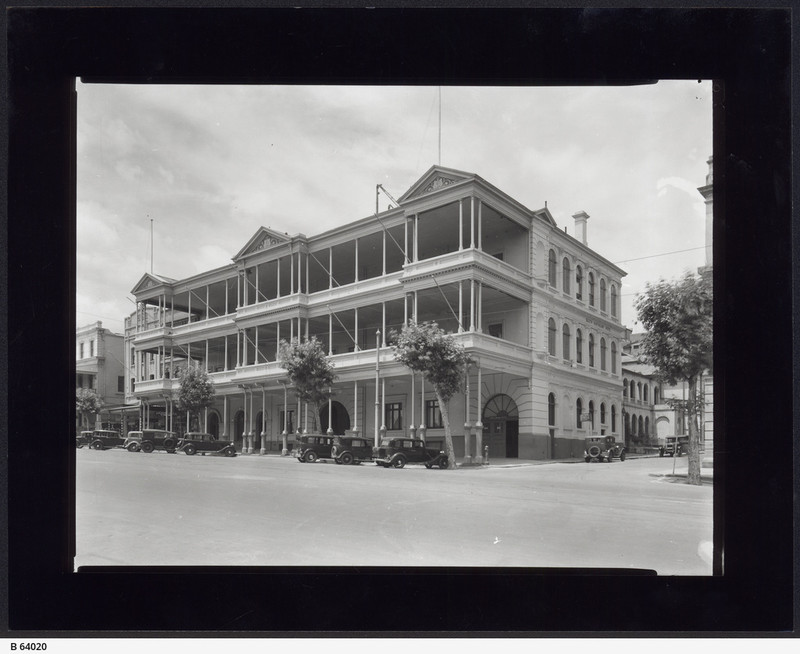
They then travelled to Adelaide, either by train or steamer ship, to reside temporarily at the Napoleon Hotel at 92 King William Street. The Napoleon Hotel however functioned primarily as a standard city pub so presumably it was not a long stay there and its likely they moved to the South Australia Hotel on North Terrace, where many wealthy British migrants, would book extended stays for their first few weeks in South Australia before purchasing property or securing permanent accommodation.
 |
 |
| Napoleon Hotel 1919 [State Library of SA B 1090] |
South Australia Hotel 1936 [State Library of SA B 164020] |
On the 14 September 1939, less than a week after arriving in Adelaide, Charles was registered to practice medicine in South Australia.[8]
But before he began his formal medical practice – he became a Flying Doctor!
Footnotes:
[7] National Archives of Australia, Passenger Arrivals Index Item 12078599
[8] Jennings, R. I. (1998). The Medical Profession and the State in South Australia, 1836-1975. University of Adelaide
CHARLES - A ROYAL FLYING DOCTOR
Charles had been in South Australia for only a few weeks when he accepted a one-month position as relieving medical officer with the Royal Flying Doctor Service (RFDS) in Broken Hill, covering for Dr John Woods, who was away at a military camp. The acting position ended on November 7, 1939.
Throughout this time, it is likely that Jean, Sophia and Irene remained in Adelaide.
In his short time with the RFDS, Charles flew thousands of kilometres across New South Wales and South Australia, carrying patients to hospitals in Broken Hill, Adelaide and Ivanhoe and treated many emergencies both in the air and on the ground, including snakebites, bullet wounds and fevers.[9]
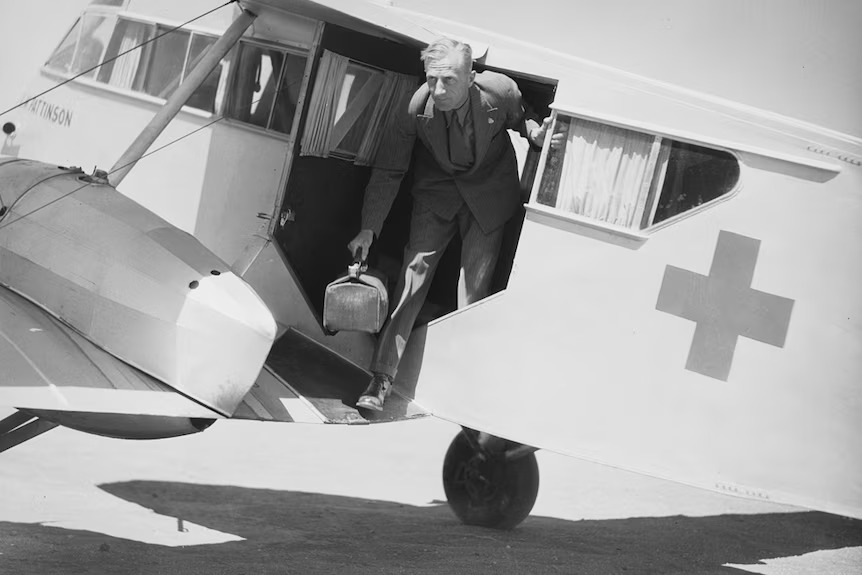 Dr. John Woods stepping out of same aeroplane that Charles would have flown in 1939 while he relieved Dr. Woods (State Library NSW)
Footnote:
[9] ABC News: https://www.abc.net.au/news/2025-03-24/royal-flying-doctor-service-releases-untold-outback-stories/105075002
WHY GRANGE?
After his short time serving with the RFDS, Charles returned to Adelaide, reunited with Jean and his family and moved to Kirkcaldy (now known as Grange).[10] It was here the doctor, missionary and committed Christian began a remarkable chapter of his life lasting from late 1939 until the early 1950s.
There is no firm evidence explaining why Charles chose Grange for his medical practice, but several possibilities emerge:
- A Medical Partnership in the Making? Charles’s older brother, Arthur John Blofeld-Moody, his wife and daughter emigrated to South Australia from Cape Town in June 1939, just four months before Charles. Like Charles, John was a medical doctor and had been practising in Cape Town at the same time Charles was there on missionary work.
Could the brothers have intended to establish a shared medical practice at Grange? It is an intriguing possibility although no evidence has yet been found to confirm it, although John’s first recorded address in South Australia was 391 Esplanade, Henley Beach! A little over a year later, John enlisted in the Australian Army Medical Corps, and served in World War II as a doctor. He returned to Henley Beach after being medically discharged in 1943 then moved a few years later with his family to Perth, Western Australia, where he continued to practice as a physician and surgeon for many years. [11] - The coastal setting. Charles was a keen yachtsman and swimmer during his years at Grange, and there is evidence in the 1994 H&GHS Journal that he was an avid sailor in his youth around Poole Harbour in England. [12] A seaside suburb would have suited him continuing these pursuits while practicing medicine.
- Advance knowledge of a need. Was Charles alerted, though the strong missionary network in Cape Town, to a community need for a doctor at Grange and an opportunity to start a new practice?
But where did Charles live when he first arrived in Grange, and where did he establish his medical practice? Sands & McDougall directories record several changes in Charles Moody’s addresses in the Grange and Henley Beach area during the 1940s and early 1950s. However, the available entries do not clearly distinguish between his residential and medical practice addresses, nor establish the precise relationship between these addresses and the ‘Beachcroft’ property he purchased during this time. Further investigation of these matters falls outside the scope of this story.
We do know however that after 1952, Charles and his family no longer appear in the Sands & McDougall listings. This coincides with the period in which Charles sold his Grange medical practice to Dr Vernon Odlum, put Beachcroft up for sale and left Grange.[13]
Besides his private practice, Charles served for 12 years[14] as medical officer to the Henley & Grange Council and worked regularly at the Henley & Grange Hospital. From 1946 onwards he also worked voluntarily at the Lady Hore-Ruthven Junior Red Cross Children’s Home. This last role in particular shows how firmly he was embedded in the Christian and community medical network of the local area.
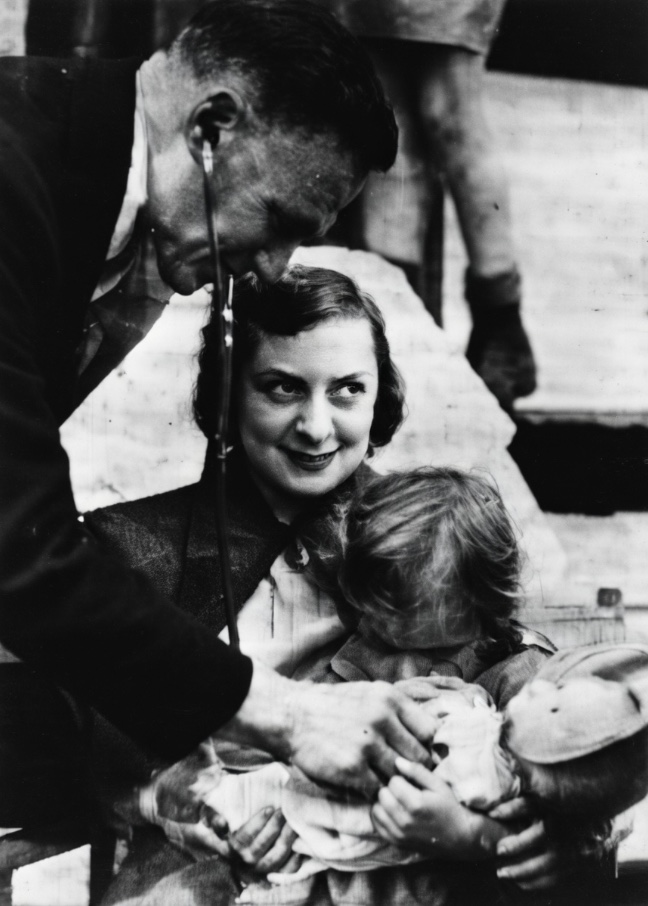 Dr Charles Moody running his stethoscope over a doll at the
opening of the Lady Hore-Ruthven Children Home, June 1946 [15]
One sad event while living at Grange was the death of his mother Sophia on the 2nd of July 1949 at his home on Seaview Road. She was 78 years old and is buried at the Cheltenham cemetery.
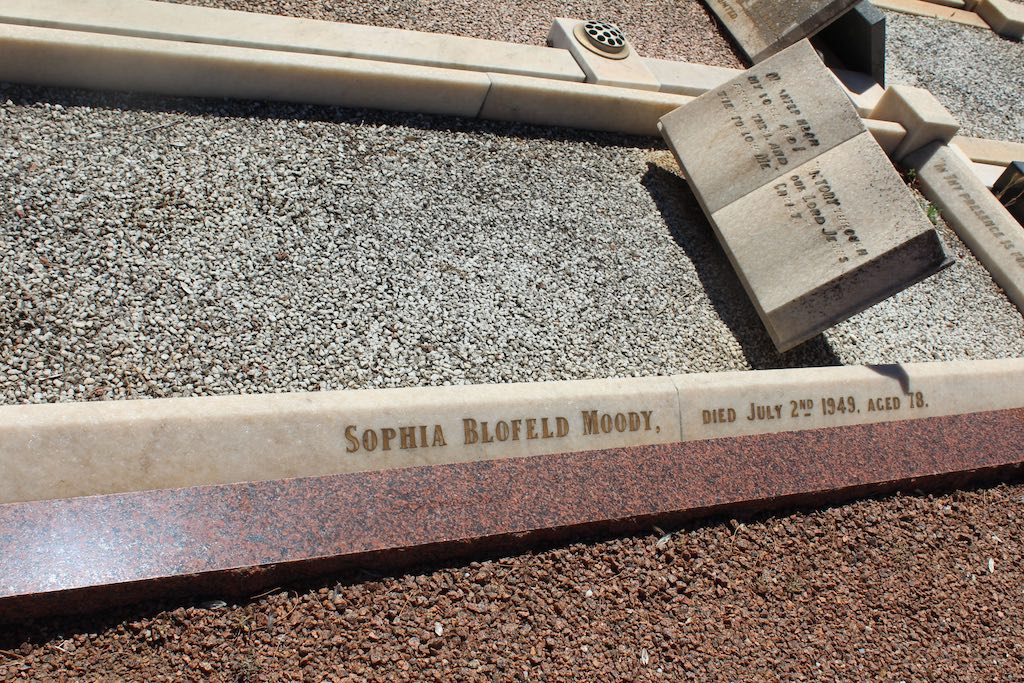
Grave of Sophia Moody, Charles’ mother at Cheltenham Cemetery[16]
Footnotes:
[10] Wikipedia https://en.wikipedia.org/wiki/Grange,_South_Australia
[11] National Archives of Australia and Ancestry.com
[12] Henley and Grange Journal 15, 1994, pp. 7-12
[13] Sands & McDougall Directories 1942, 1943, 1944-5, 1946, 1947, 1948, 1949, 1950, 1951, 1952, 1953
[14] National Library of Australia: Trove, The Advertiser, Aug 5, 1952
[15] The News, Tues 11th of June 1946, p. 3 “Home at Henley for children at Henley Beach” https://trove.nla.gov.au/newspaper/article/129994522
[16] Find a Grave https://www.findagrave.com/memorial/185476686/sophia_blofeld-moody/photo#view-photo=296972768
GRANGE BOYS AND GIRLS CLUB
Although his medical practice occupied much of his working day, Charles soon became concerned about the lack of constructive activities for the young people of Grange. His experiences overseas, together with his strong Christian beliefs, had instilled in him a deep sense of service and a conviction that young people should be encouraged to develop physically, mentally and spiritually.[17]
According to an account in the H&GHS Journal 15, [18] Jean remembers that within months of their arrival Charles would often head down to the beach for a swim after work. It was during these visits, she remembered, that he began to recognise the need for more worthwhile activities for local young people. Drawing on his own skills as a proficient gymnast, he soon took an active role in the community and established a gymnasium club. In 1940, this initiative developed into the Grange Boys and Girls Club, which was renamed the Grange Christian Centre in 1947. Its aim was to foster the development of young people in body, mind and spirit.
It became the organisation for which Charles would be best remembered in the district.
Initially, the club met in the disused Grange Sea Scout Hall near the south-eastern corner of Jetty and High Streets. Charles conducted the gymnastics himself, while Jean, his sister Irene, a trained masseuse and his mother Sophia all helped with the activities. From the outset, membership involved more than gymnastics and recreation as boys and girls were also expected to attend Christian classes and participate in a range of group activities.
During the early 1940s, membership grew dramatically, reaching about 100 boys and 70 girls, and larger premises became necessary. In 1948, Charles purchased “Beachcroft”, a substantial property on the southern corner of Grange and Seaview Roads, originally built for the prominent Scarfe family of Adelaide. The seller was the financier Ossie O’Grady, a strong supporter of the Boys and Girls Club. Partitions between the stables, coach houses and a room in the outbuildings of Beachcroft on the Seaview Road boundary were then removed to create a “hall” for the centre’s expanding programme of gymnastics, and Christian activities.
Charles also established the Beachcroft Sailing Club, encouraging girls to sail as well as boys.[19]
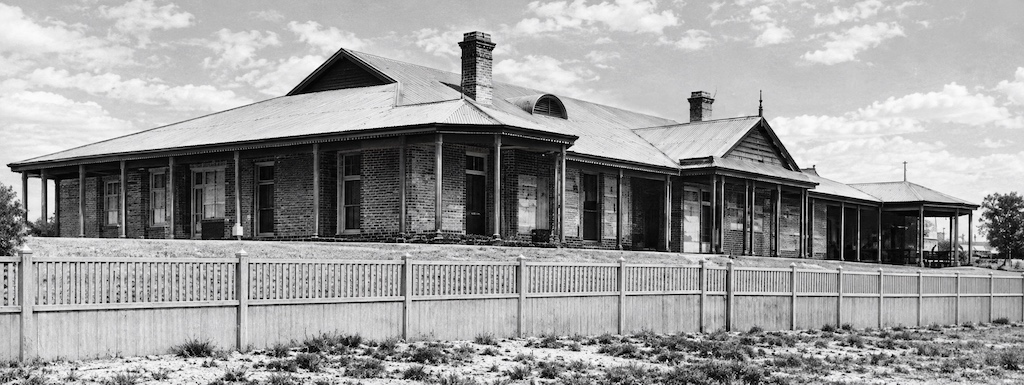 Front view of ‘Beachcroft’, 589 Seaview Road, Grange c. 1948
(Courtesy of Peter Goldsmith – restored by AI)
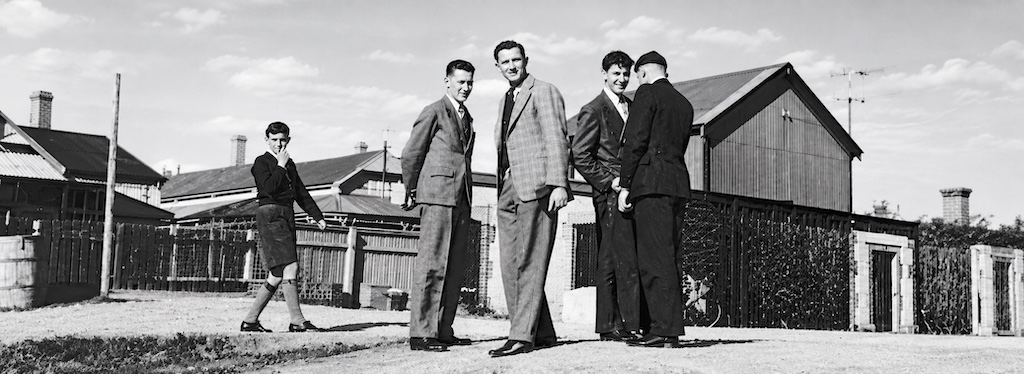 Rear view of ‘Beachcroft’, 589 Seaview Road, Grange c. 1948
(Courtesy of Alan Compton – restored by AI)
Charles was greatly loved and admired by the young people from the club and had a marked influence on their lives.[20]
Footnotes:
[17] Email from Alan Compton June 26, 2016 (H&GHS Collection)
[18] Henley and Grange Journal 15, 1994, pp. 7-12
[19] Henley and Grange Journal 15, 1994, pp. 7-12
[20] Henley and Grange Journal 34, 2013, pp. 15-16
SWIMMING AND SAILING STORIES
This section contains several published stories involving Charles which are associated with swimming and sailing while he was at Grange.
SWIMMING CHAPERONE
Charles was a swimming chaperone in the 1945 long swim from Henley to Grange in which he rendered safety, and welfare role tasks with the supervision, physical care, and moral oversight for two 10 and 11year-old boys competing in the swim.
Source: Trove, The News, Sat 24th February, 1945
DR MOODY TO THE RESCUE – AUSTRALIA’S FIRST SWIMMING DOCTOR
When Beachcroft Sailing Club boats were competing for the C. W. Smith Cup and trophy on Sunday, an emergency signal was hoisted from the club shed.
Dr. C. A. Moody, of Grange, who was competing in the race, immediately dived overboard and swam ashore. He then performed an operation at a nearby hospital. While the doctor was ashore Don Martin continued the race for him. As soon as he had finished the operation. Dr. Moody rejoined his yacht, per rowing boat, and finished third.
Dr. Moody, a keen member of the club, has made careful arrangements so that he may be summoned if he is wanted, even while taking part in a race. The starting apparatus of the sailing club, which adjoins Dr. Moody’s home on the foreshore, is used. When the doctor is wanted urgently a Union Jack is flown at half-mast from the apparatus. The operator at the club-shed can identify the doctor’s boat by a red cross on its sails.
Source: Goulburn Evening Post, Thursday March 2, 1950
SAW CANOE – HAD TO GO
Shortly before the canoe in Friday’s tragedy off Grange Jety capsized in a squall, a doctor was watching it through a telescope. Then he had to go away on his medical round.
In the tragedy on Friday Arthur David Bulbeck, 22, of Palmer place, North Adelaide, was drowned. Pamela Dodd, 18, of Meningie, supported him in rough seas for three hours before they were picked up by the Harbors Board pilot launch. The doctor, Dr. C. A. Moody, of Esplanade, Grange, said today, “I think I would have been able to get to the couple in time. There were boats on the beach I could have used”.
Later, Dr. Moody was called to Grange Jetty to attend to the couple. He found that Bulbeck had a small abrasion on the forehead. “He probably hit his head on the boom of the canoe.” said Dr. Moody. This, he added, would have been enough to make Bulbeck unconscious and put his head under the water although supported by the lifebelt and Miss Dodd.
Source: News, Monday 8th August, 1949
ELIZABETH O’GRADY – A LIFE CUT SHORT
Elizabeth O’Grady, daughter of financier Ossie O’Grady of Grange, was training to become a kindergarten teacher when she died suddenly in 1952, aged just 18. She was a valued member of Dr Charles Moody’s ‘Grange Boys and Girls Club’ and the Beachcroft Sailing Club where she served as secretary, reportedly the only woman in South Australia to hold such a position at the time. Her enthusiasm and considerable sailing ability made her an important part of the club’s activities.
Elizabeth’s death was reportedly sudden and occurred while she was asleep. A later oral-history recollection refers to her epilepsy as a possible cause, although the precise medical circumstances have not been independently confirmed. Elizabeth’s untimely death was a sad loss to both clubs and to Charles Moody, who had worked closely with her.
Sources:
Trove, The News, Sat 24th February, 1945
News Friday 23 May 1952, p.19
The Advertiser Friday 9 November 1951, p.6
The Advertiser Friday 27 June 1952 p.11
State Library of South Australia OH 728/35, 31 May 2006, Miller, H.
State Library of South Australia OH 728/42, 9 April 2006, Miller, H.
H&GHS Journal 15, 1994, pp 7 – 12
H&GHS Journal 34, 2013, pp 15 – 16
THE GOOLWA CONNECTION
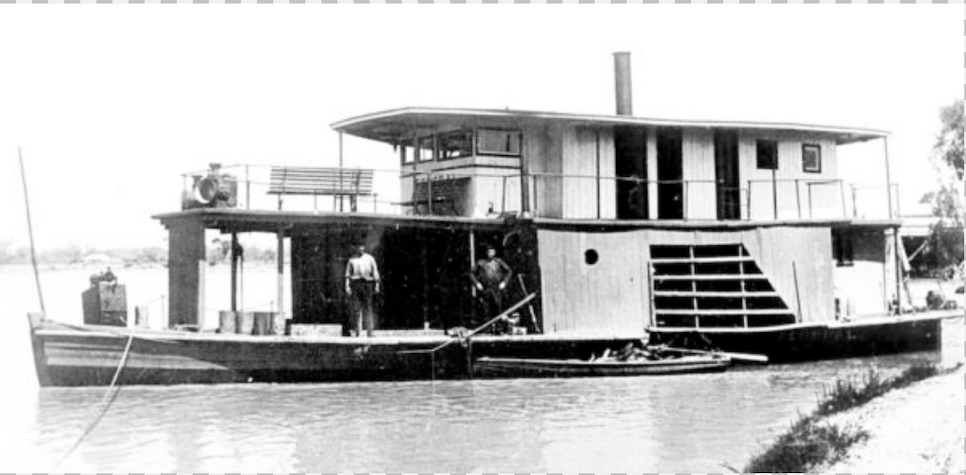
In early 1952, Charles purchased the paddle steamer P.S.Federal, built in 1902 to commemorate Australian Federation and originally used as a working river-trading vessel, carrying firewood and general supplies along the River Murray.
He envisaged giving the vessel a new purpose: providing holidays for disadvantaged young people and teaching navigation to boys and girls from the Grange Christian Centre. When he had worked as a medical officer with the North Sea fishing fleet, Charles had acquired navigation skills, which he drew upon to bring the steamer from Mannum to Goolwa, including navigating the potentially treacherous waters of the lower lakes near the Murray Mouth.[21]
After purchasing the steamer, Charles renamed it Ipana. He had the engine removed to create additional space for accommodation and invested considerable effort and money in renovating the vessel. Although the plans for its new role were evidently ambitious, there is currently no evidence that the proposed outreach programme was ever fully implemented. For a man accustomed to turning ambitious ideas into successful ventures, the apparent failure of this project must surely have been a considerable disappointment, although we have no record of how Charles himself regarded its outcome.
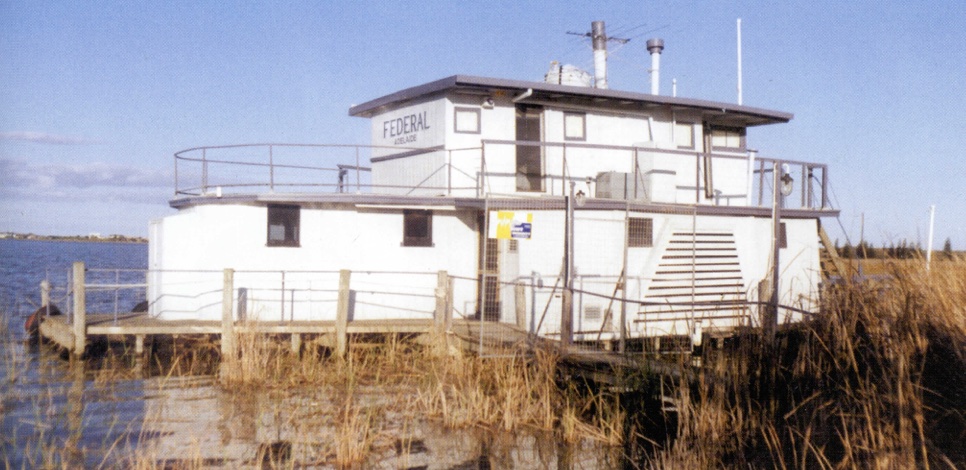
The P.S.Federal appears to have been a houseboat ever since, excluding the time when it sat at the bottom of the river near the barrage at Goolwa up until 1996.[22]
It now serves as a unique luxury accommodation option anchored in Goolwa, South Australia.
 |
 |
| P.S.Federal at Renmark – 1930 [State Library of SA PRG 1258/1/1178] |
P.S.Federal at Goolwa 2026
|
Footnotes:
[21] Victor Harbour Times, Friday April 25, 1952, p.3
[22] Goolwa History Society (personal communication)
AFTER GRANGE
By early 1952, Charles appears to have been preparing for a decisive change in direction.
In May 1952 “Beachcroft” was advertised for sale and interestingly Charles was prepared to offer vendor finance, agreeing to leave part of the purchase price outstanding as a mortgage for three to six years at 4½ per cent interest. This suggests that he was keen to facilitate a fast sale, although whether this reflected particular urgency or was simply an attractive incentive to prospective buyers is uncertain.
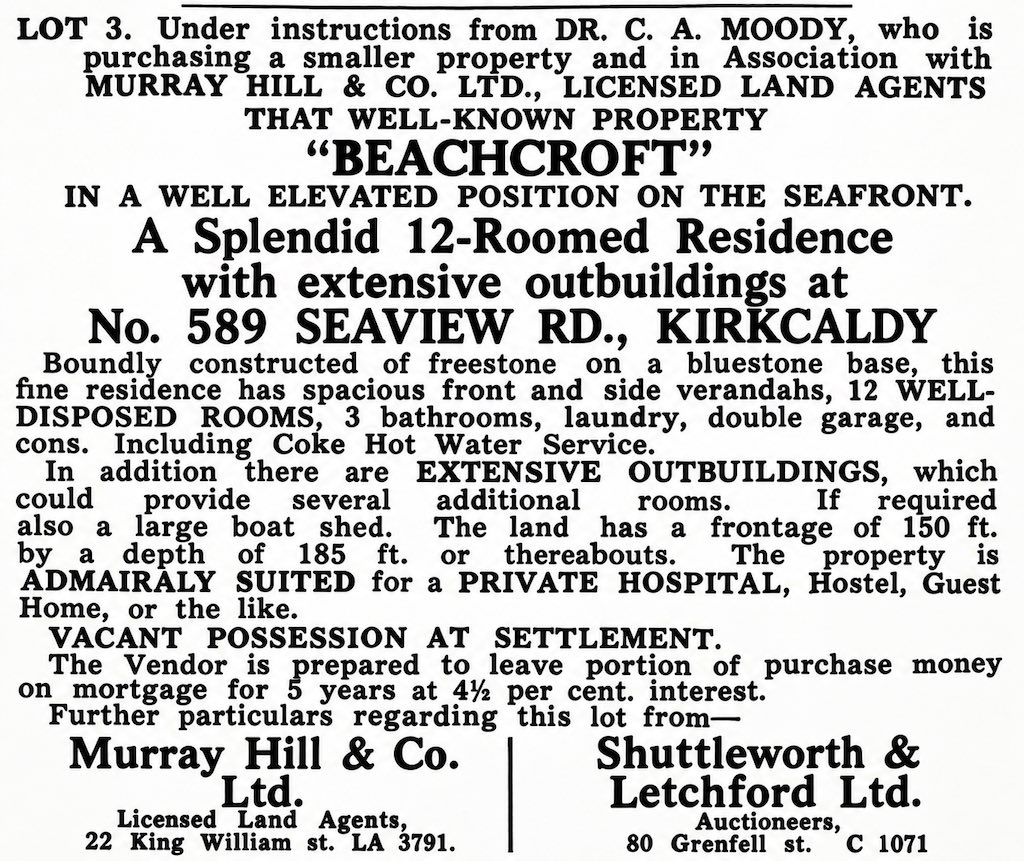 |
Advertisement for the sale of Beachcroft
The Mail, Saturday May 31, 1952, p. 41 [23]
Next came the sale of his medical practice to Dr Vernon Odlum.[24]
What prompted his change of direction remains uncertain. One possibility is the disappointment associated with the apparent failure of the “Ipana project” earlier that year. Could it be that the missionary influence that had shaped so much of his life was calling him once again? Medicine was only one part of Charles’s vocation, and missionary and Christian welfare work remained extremely important to him. There is also evidence from people who knew him at the time that the Grange Christian Centre, which he had founded, was in decline and that Charles had become increasingly dissatisfied with its growing secular focus.[25]
Whatever circumstances lay behind the decision, Charles did not remain at Grange for very much longer. In August 1952, he sailed for Ocean Island (now known as Banaba) to take up a position as Medical Officer with the British Phosphate Commission (BPC)[26] where responsibilities extended beyond treating patients to include management of the hospital infrastructure serving both BPC employees and the Banaba population.
But his appointment at Ocean Island only lasted about a year. It is likely Jean accompanied him there, as Irene had not be living in Grange for several years, having returned to Capetown where she was practising as a private masseuse in the mid 1940s.[27]
Then from Ocean Island he joined the Northern Territory Medical Service in October 1953. The succession of short postings during these years was not unusual for doctors who were willing to take on remote or short-term positions in the postwar period, though it is equally possible the pattern reflects something of Charles’s own restlessness at this stage of his life. He is recorded working at Darwin Hospital in April 1955, but he must have moved on soon after, as by October 1955 he was in Queensland as a senior resident medical officer at the Bundaberg Hospital.[28]
But this too was only a relatively short term appointment, as he resigned in early 1957 to take up missionary service once again, preparing this time to use his 40-foot (12.2 metres) launch ‘Crusader’ to travel 1,220 miles (1,930km) along the Queensland coast, then across the Torres Strait to Daru, at the mouth of the Fly River in Papua New Guinea, for service with the Unevangelised Fields Mission (UFM).[29] Accompanied by his 16-year-old son Peter, Charles intended to live aboard the launch and use it to travel the Fly River, visiting remote mission dispensaries. He had fitted Crusader out as a houseboat, combining his medical skills, missionary calling and lifelong interest in boats and navigation in an unusually practical form of remote medical ministry.[30]
Perhaps this period of his life was, arguably, the highlight of his long career, though how, why and when it ended is unclear.
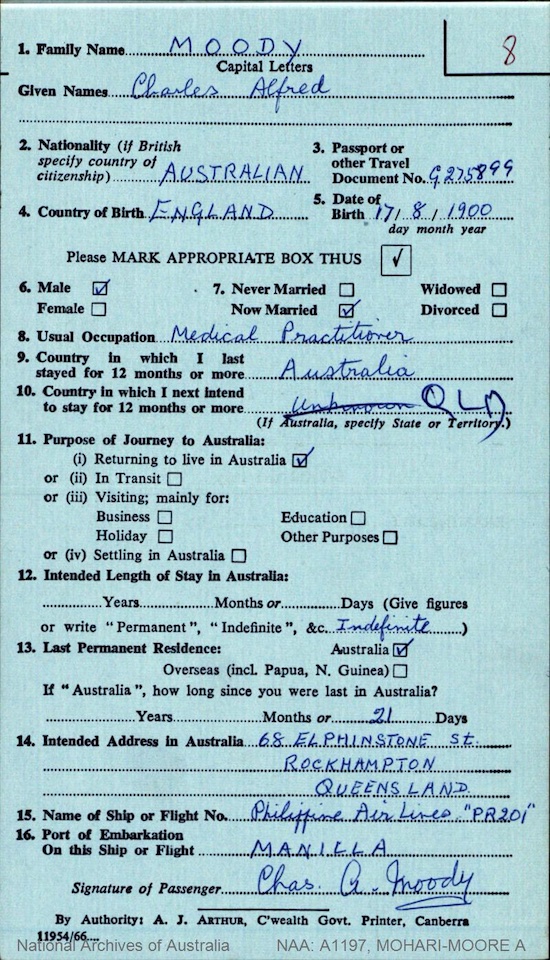
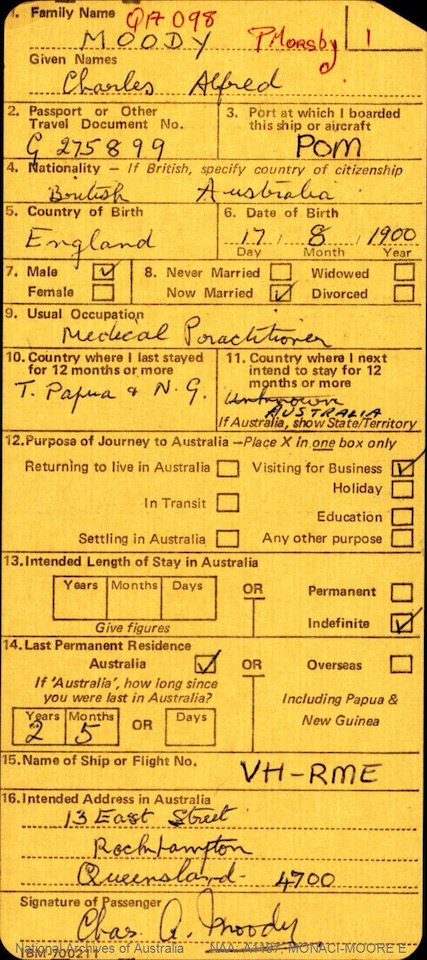
After leaving the UFM, Charles continued short term medical, missionary and welfare work from 1963-1970 in Nadi, Manilla, Papua New Guinea and Hong Kong as the selection of incoming international passenger arrival records show below. During this time his home addresses in Queensland were in Bundaberg, Rockhampton, Clayfield, Nambour and Ninderry.[31]
 |
 |
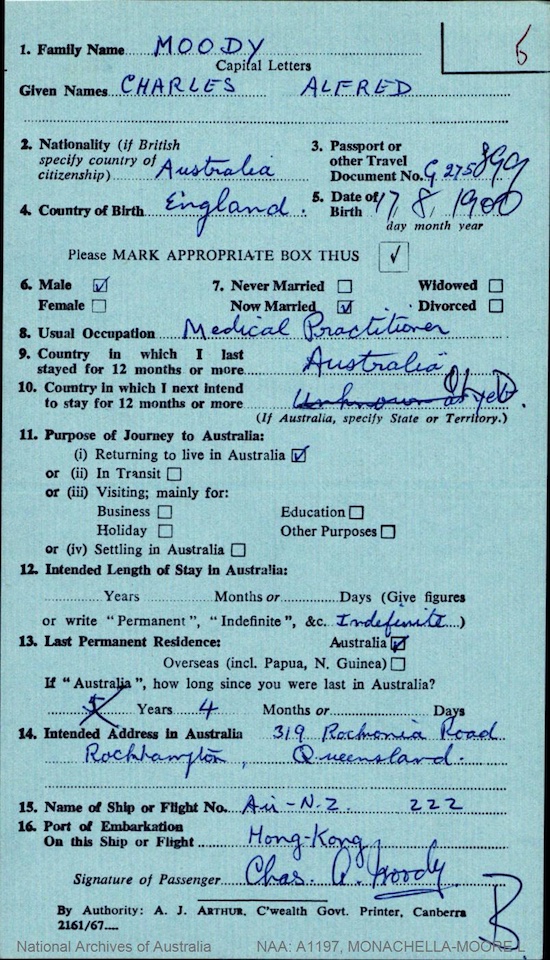 |
A selection of incoming passenger arrival records for Dr Charles Alfred Moody
No clear record survives of his private, medical or missionary life after this time.
He died on 17 May 1988, aged 87, and is interred at the Kulangoor Lawn Cemetery on the northern outskirts of Nambour, Queensland. [32]
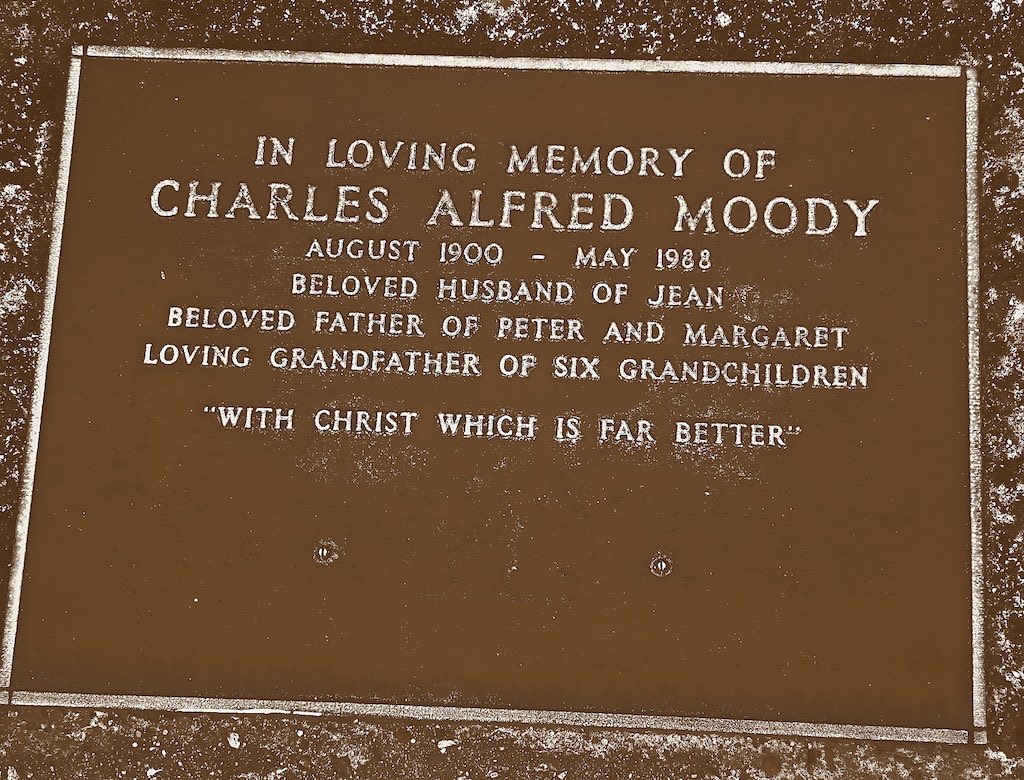
Charles Alfred Moody Plaque, Kulangoor Lawn Cemetery, Queensland
Footnotes:
[23] National Library of Australia: http://nla.gov.au/nla.news-article57696320
[24] H&GHS 1994, Journal 15 pp. 7-12
[25] Email from Alan Compton June 26, 2016 (H&GHS Collection)
[26] National Library of Australia: SA Doctor for Ocean Island https://trove.nla.gov.au/newspaper/article/47419957
[27] Ancestry.com.au
[28] Bunderberg News, 27th October 1955
[29] Charles Micheals, C. 2022, MAPANG Its Mission, Outreach, Workers and Missionary Home, Aiyura Valley Historical Society
[30] Doctor Sails His Home: Pacific Islands Monthly 1957 https://pacificislandsmonthly.com
[31] National Archives of Australia: Incoming International Passenger Records A1197
[32] Find a Grave: https://www.findagrave.com/memorial/157432227/charles-alfred-moody
JEAN AND IRENE
Jean Christian McLaurin Moody (nee Maddox) [33]
Charles’s wife Jean was born in the UK in December 1914, one of 13 children, with seven brothers and five sisters. After leaving Grange, electoral records show her living with Charles in several Queensland centres, including Nambour, Rockhampton, Bundaberg, Clayfield and Ninderry from 1958 until the 1980s. She died in 2002, aged 88.[34] No formal death, funeral or cemetery records have been located.
Jean and Charles had two children Peter John and Margaret Jean.
Irene Grace Moody [35]
Irene was Charles’s younger sister, born in 1902. She came to Grange with him, Jean, and her mother Sophia in 1939 but lived and worked as a masseuse for only a few years as she is listed in the U.K. Directory of Chartered Physiotherapists as practicing privately as a masseuse in Green Point, Cape Town, South Africa in 1946.
She never married.
Incomplete evidence from electoral roll records suggest she returned to Australia, working as a secretary in New South Wales in 1958 before taking up mission work around 1963 and retiring in 1968. She moved to Western Australia to be with her older brother John, within the next few years, and died there in 1975, aged 73. She is buried in the Karrakatta Cemetery, Western Australia. No formal death or funeral notices have been located.[36]
Footnotes:
[33] Ancestry.com.au
[34] Ryland Family Tree: https://ryeland.com/getperson.php?personID=I8300&tree=Ryeland
[35] Ancestry.com.au
[36] Find a Grave: https://www.findagrave.com/memorial/213738842/irene-grace-moody
NOTES
Generative Artificial Intelligence (AI) has been used in refining the narrative of this article by improving flow and grouping related details without altering the factual integrity of the research.
Some images (where appropriate) have been restored by AI to improve clarity.
Researched and published by:
Roger Edmonds (July-Oct, 2026)
Reviewed by:
Dr Mervyn Allen (Oct, 2026)
Ms Marie Hagen (Oct, 2026)
0 Comments