
BADENOCH’S BEACH BAKERY
Cover Photo and Disclaimer
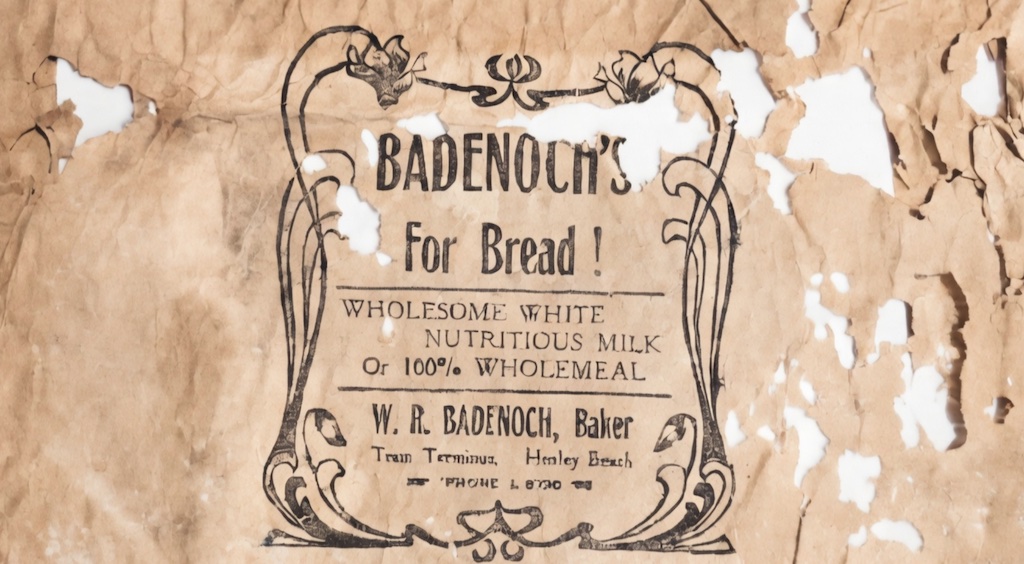
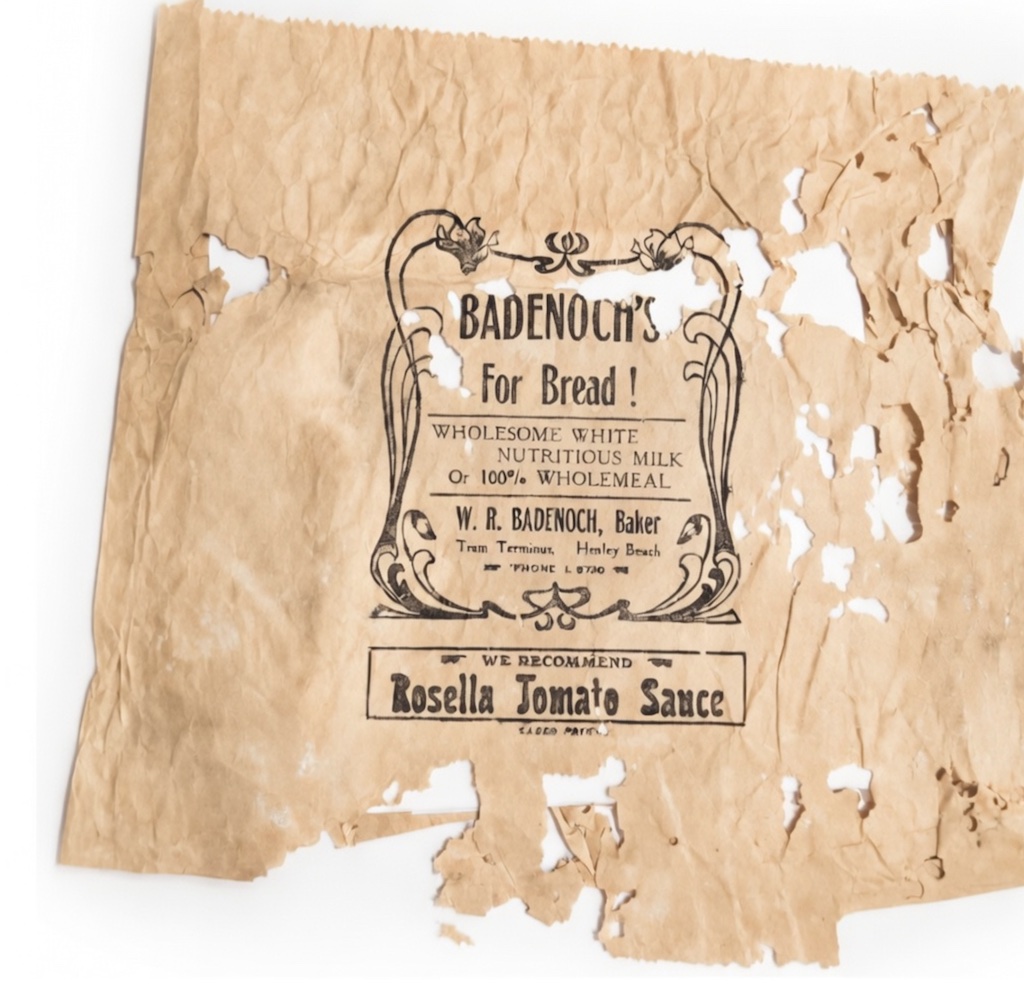
Found beneath floorboards, this weathered and fragile fragment of a Badenoch’s bakery paper bag (c. 1926) is a surviving relic of a long-vanished business and the local community it faithfully served.
(Kindly donated to the Henley & Grange Historical Society Collection)
Disclaimer:
This article presents a short history of the Badenoch bakery business at Henley Beach and is based on available historical evidence. Information has been drawn from material held in the Henley & Grange Historical Society Collection (including Journals), together with external websites, newspapers, published works, and academic research. Some sources reflect the recollections and interpretations of their authors and while every reasonable effort has been made to verify this information against primary sources and ensure historical accuracy, the Henley & Grange Historical Society cannot guarantee that all content is complete, accurate, or free from error. Images and other media have been used under Creative Commons licences, are in the public domain, or have been reproduced with permission and appropriate attribution to the copyright holder. This article is intended solely for historical, research and educational purposes. No offence to any person, living or deceased, is intended.
EARLY HISTORY
The Badenoch Bakery and Grocery Store commenced trading at Henley Beach in 1917 from a prominent building on the north-east corner of Henley Square at 414 Seaview Road, directly opposite the Ramsgate Hotel.
The business operated from this landmark location until 1954 then on its closure, the building underwent a number of transformations, serving at various times as a Commonwealth Bank branch and later as a succession of cafés and coffee shops.
Today (in 2026), the site is once again associated with the craft of baking, being home to ‘Taste Baguette and Bowl’, where handcrafted sourdough breads and delicate pastries continue a tradition of baking on this historic corner.
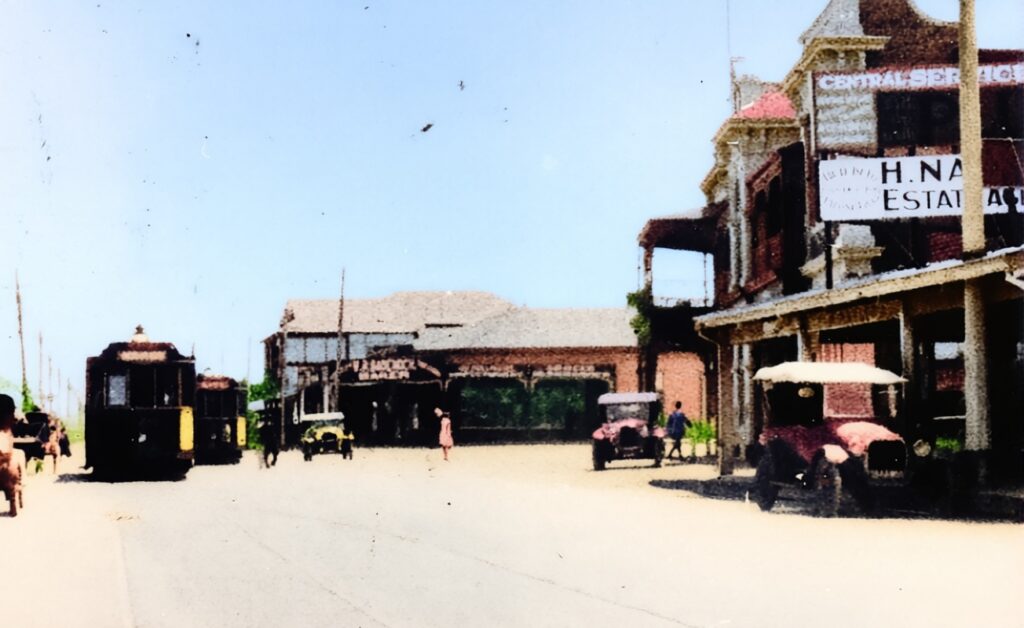 Seaview Road looking north to Badenoch’s Bakery and Grocery Store c. 1924
(HG 26 PH – Henley & Grange Historical Society Collection – edited and colourised by AI)
Before becoming the home of Badenoch’s Bakery, the prominent corner site was leased by A. W. Ralph, as a bakery which also supplied groceries, refreshments and everyday necessities to Henley Beach residents and visitors.
In 1916, W.R. (William Robert) Badenoch Snr. purchased the business from the owner Mr J. Farrant and converted it into what became the well-known Badenoch bakery and grocery store in partnership with his sons, W.R. Badenoch Jr., Claude and Roy. Following William Snrs. death in 1922, Claude and Roy left the partnership to pursue separate careers and the bakery and grocery business was then owned and managed by W.R. Badenoch Jr. and his mother, Sarah, until her retirement in 1923.
In 1941, W.R. Badenoch Jr. formed a new partnership, W.R. Badenoch & Sons, with his and his wife Betsy’s two sons, Robert William (Bob) and Malcolm Eric (Mal) and together they continued operating their bakery and grocery business. After their father’s death, (W.R. Badenoch Jr.) in 1946, the brothers then pursued different directions within the family enterprise. Bob continued with bread making, first at Henley Beach then at the Associated Baking Corporation facilities in Seaton, while Mal established a cake manufacturing operation at Underdale.
Bob left the partnership in 1953, while Mal continued to expand the cake manufacturing side of the business. Then, during the 1960s, a series of business amalgamations and factory relocations took place until finally, in 1969, the company, then trading as Badenoch Sunshine Food Products, was acquired by George Weston Foods.
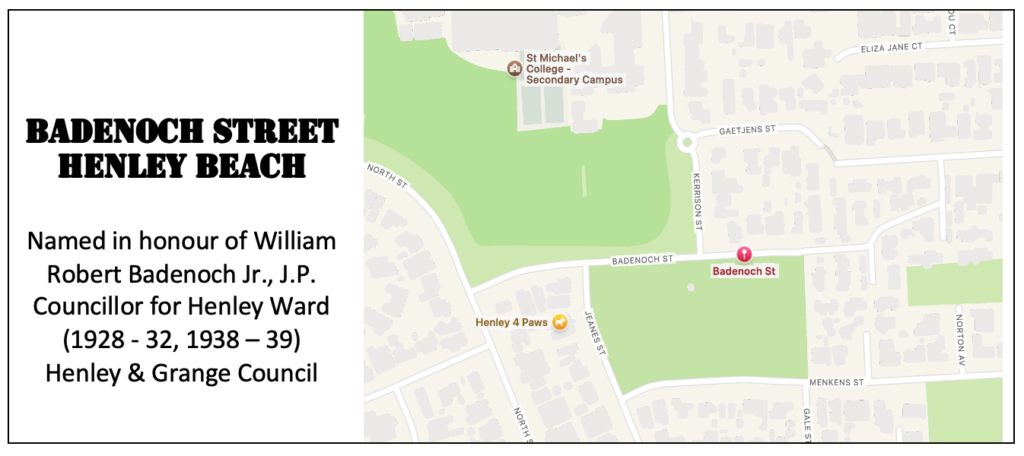
During this time, the Badenoch family home was located at 32 North Street, Henley Beach, behind which were stables for the horses who pulled the bakery’s delivery carts. The families also owned several other properties in Henley Beach – in North Street, Chester Street and East Terrace.
Bob Badenoch talking in 1982 about his family and bakery (2m 30s)
[Original recording edited and remastered using AI by the H&GHS]
Research Sources:
Henley & Grange Historical Society, Journal 3, 1982, p.7-9
Seaview Road looking north to Badenoch’s (HG 26 PH – Henley & Grange Historical Society Collection)
Brief History of the Badenoch Company (HG CB 2 VF – Henley & Grange Historical Society Collection)
The history of W.R. (Bob) Badenoch & Sons, a successful Henley Beach Bakery business since 1917 (HG 0782ab AU – Henley & Grange Historical Society Collection)
State Library of South Australia – Almanacs and Directories online
National Library of Australia https://trove.nla.gov.au/newspaper/article/87435356
WikiTree – W.R. Badenoch Family History
Ancestry – W.R. Badenoch Family History
BAKING THE BREAD
The key component of any bakery are its ovens!
The Badenoch Henley Beach bakery like so many other bakeries of the time used Scotch ovens, for baking bread. They were about 12 feet (3.6m) by 15 feet (4.5m), had a capacity of baking 230 loaves and were wood fired, using stringy bark and cut mallee as fuel. The furnace was at the right-hand side of the oven, and the oven floor was made of fire bricks (similar to that shown in the photo below).
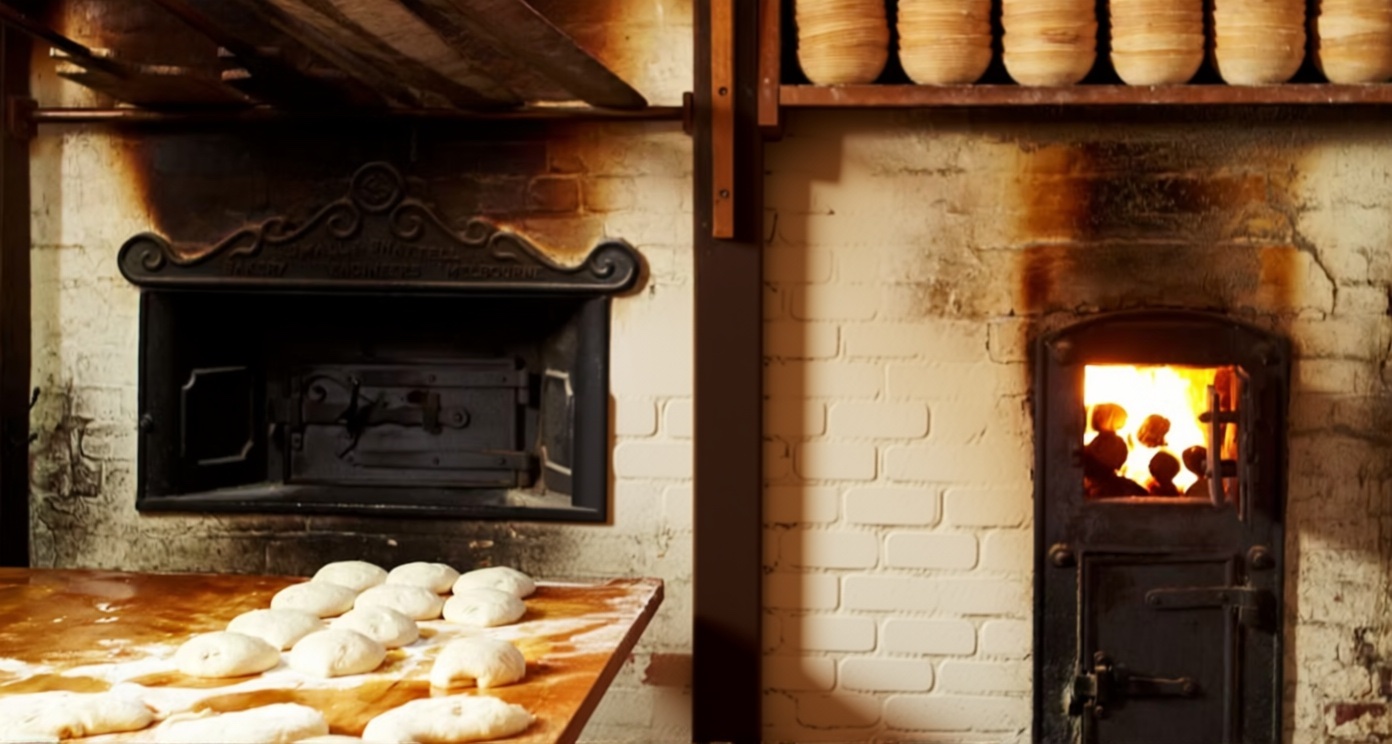 Scotch Oven (left) and wood fired furnace (right)
(Image courtesy of Redbeard bakery https://www.redbeardbakery.com.au/our-story)
Learn more about Scotch Ovens
Scotch ovens are traditional woodfired commercial bakers’ ovens. A Scotch oven has an arched ceiling, a fire box on one side of the main chamber and a flue on the opposite side. The oven’s shell comprises massive layers of brick and sand. A Scotch oven stores heat wonderfully well in its massive masonry structure. The fire is extinguished before baking commences and the bread is bathed in deep and even heat that is gradually released by the bricks and sand.
For more information read Haden, R., (2006) Australian history in the baking: The rebirth of a Scotch oven, Journal of Australian Studies, 30:87, 61-73, DOI: 10.1080/ 14443050609388051 which can be downloaded from http://dx.doi.org/10.1080/14443050609388051
The only mechanical piece of machinery at the bakery was a ‘Dough-it‘ machine, a large circular mixer powered by a 5HP motor. Above it was a tank of water for mixing with the flour. This water had to be kept at a constant temperature of 78 degrees Fahrenheit (or 25.5 degrees Celcius) to achieve the best baking results. In winter, kerosene tins of water, heated in the oven, had to be added, and in summer, blocks of ice from Johns’ butcher shop were used to keep the water at this optimum temperature. The dough was then scaled off, (i.e. dividing a large, bulk batch of fermented dough into individual, precise portions) before being cut then moulded and shaped – all by hand. Moulding was a ‘real art.’
Before baking, the floor of the oven had to be ‘scuffled.’ This was done by rotating a wet chaff bag on the end of a wooden kauri pole, 12 or more feet long (3-4 m) to clean the ashes off the fire bricks.
Badenoch’s at Henley Beach would make about 3,000 loaves of bread each week.
Bert Busbridge, Edgar Whitbread and Brent Jacka were some of Badenoch’s Henley Beach bakers.
Part 1 of Bob Badenoch talking in 1982 about baking bread at Henley Beach (3m 56s)
[Original recording edited and remastered using AI]
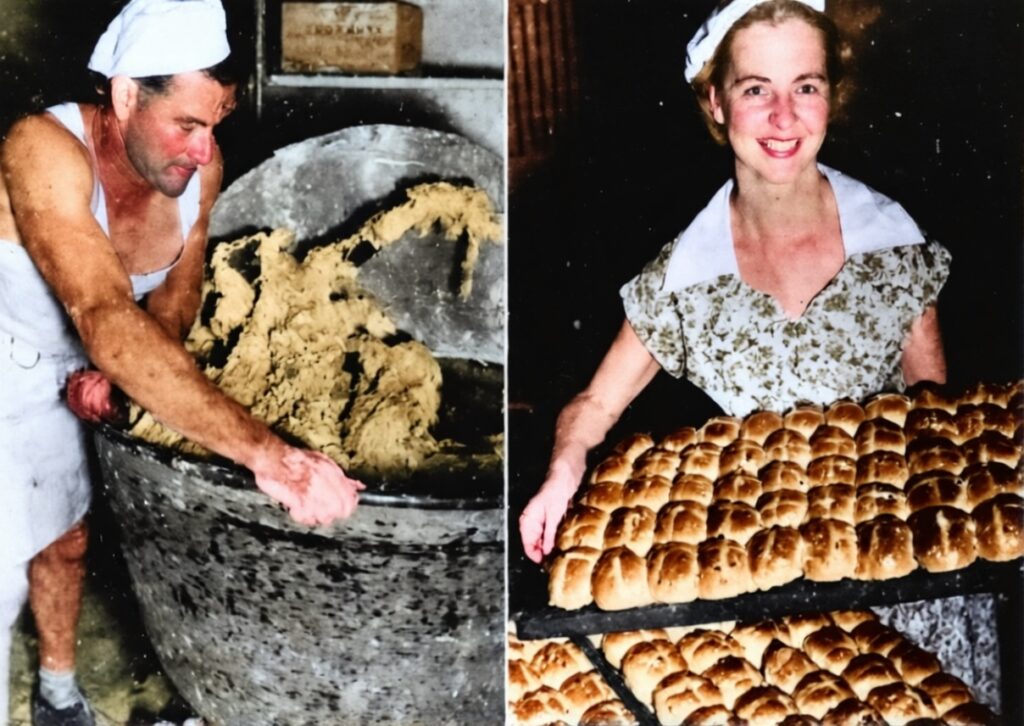 Bob Badenoch (left) mixing dough and Gene Badenoch (Mal’s wife – right) lifting a tray of hot cross buns from the oven
(Image courtesy of Trove, National Library of Australia)
(Original photo restored and colourised by AI)
Part 2 of Bob Badenoch talking in 1982 about baking bread at Henley Beach (4m 49s)
[Original recording edited and remastered using AI]
Research Sources:
Henley & Grange Historical Society, Journal 3, 1982, p.7-9
Brief History of the Badenoch Company (HG CB 2 VF – Henley & Grange Historical Society Collection)
The history of W.R. (Bob) Badenoch & Sons, a successful Henley Beach Bakery business since 1917 (HG 0782ab AU- Henley & Grange Historical Society Collection)
Haden, R. (2006) Australian history in the baking: The rebirth of a Scotch oven, Journal of Australian Studies, 30:87, 61-73, DOI: 10.1080/ 14443050609388051
Redbeard Bakery https://www.redbeardbakery.com.au/our-story
National Library of Australia (Trove) https://trove.nla.gov.au/newspaper/article/48303267
DELIVERING THE BREAD
Much of the Badenoch’s bread was delivered to local homes – to their back doors first of all, then, under the requirements of wartime, to the front door or front gate.
Do you know why this was?
Click HERE to find out why
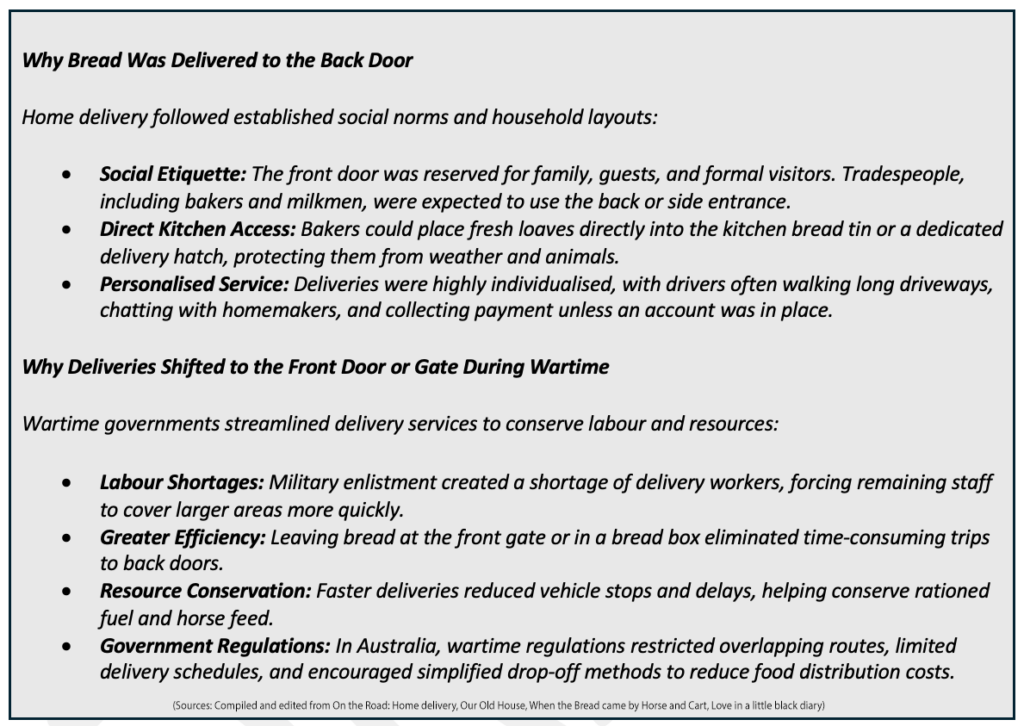
The back door deliveries were exceedingly wasteful of time – with not many more than 100 deliveries per day made by each carter. With front door deliveries and war-time zoning, many more deliveries could be made.
Home delivery remained popular until the mid-20th century, when modern supermarkets and home refrigeration made daily door-to-door deliveries obsolete.
Bread carters employed by Badenoch’s at Henley Beach included Ernie Lanyon (who had the north run, to Kirkcaldy, Grange and Estcourt House), Cliff Jeffries and Ralph Lavis. Apart from a Chevrolet car which had been turned into a van, horse-carts were used. The two-wheeler carts had very tall wheels with no shelter for drivers and were most uncomfortable in the rain! Some northern parts of Military Road were really only passable by horse-drawn vehicles as potholes could be very deep!
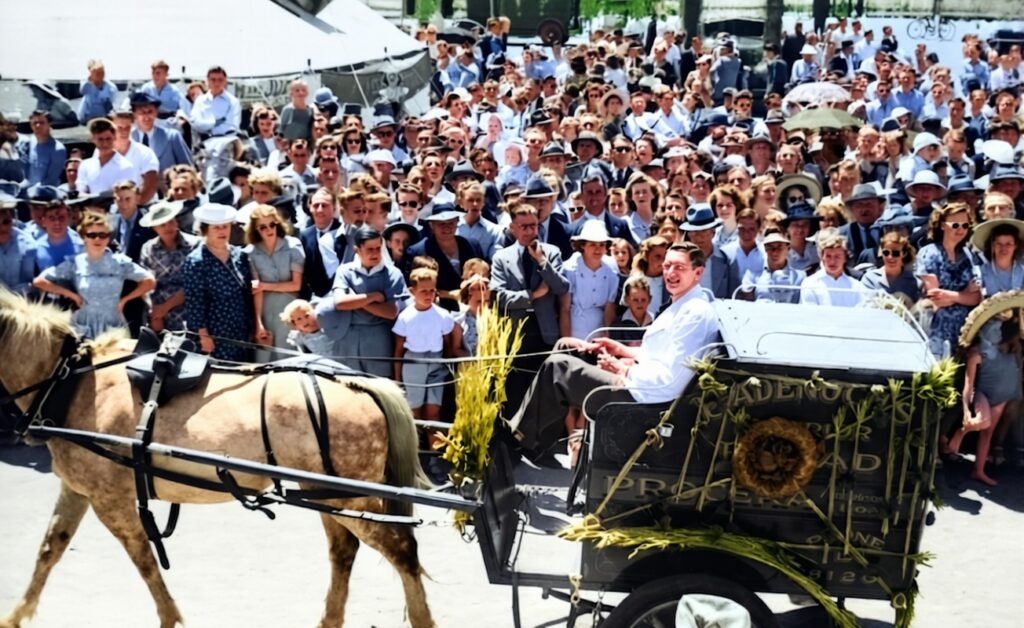 Badenoch’s Bakery Cart and Horse, Henley Beach Carnival
(Henley & Grange Historical Society Collection – edited and colourised by AI)
Badenoch’s horses were regarded with affection, and as individuals. Laddy knew every bread round and every grocery round, and, in flood time, his services were often called upon to pull the family car from the broad torrent of water pouring over the concrete road. Tom was called Old Tom as he lived on to 25 years of age. And no check rein could hold Mick when he sighted cabbage leaves left beside the road by Noel Newcombe’s father.
Bob Badenoch talking in 1982 about delivering bread (4m 51s)
(Original recording edited and remastered using AI)
Apart from bread, various other yeast goods, and pies and pasties and groceries were delivered. Bread was four pence (or $0.03 cents) a loaf. Pasties were delivered to Manser’s Henley Primary School shop for 2/6 a dozen. Pies and pasties were also delivered to Vic Bergemann’s Henley jetty kiosks.
Bob Badenoch talking in 1982 about delivering yeast goods, pies and pasties (2m 40s)
(Original recording edited and remastered using AI)
Research Sources:
Henley & Grange Historical Society, Journal 3, 1982, p.7-9
Badenoch’s Bread Cart at the Henley Carnival 1970 (HG 575 PH – Henley & Grange Historical Society Collection)
Brief History of the Badenoch Company (HG CB 2 VF – Henley & Grange Historical Society Collection)
The history of W.R. (Bob) Badenoch & Sons, a successful Henley Beach Bakery business since 1917 (HG 0782ab AU- Henley & Grange Historical Society Collection)
When the Bread Came by Horse and Cart – https://australiarememberwhen.net.au
HENLEY AND GRANGE CARNIVALS
The annual summer Henley and Grange Carnivals usually began with a street procession from the Grange jetty, along Seaview Road to the Henley Hotel, and back along the Esplanade to the Henley jetty.
The procession featured highly decorated vehicles, marching brass bands, and massive food distributions, and drew huge crowds who lined the sides of Seaview Road and the Esplanade.
Badenoch’s bread carts and their horses were part of the Carnival procession. The carts were highly decorated, and the horses had beautiful brass-mounted harnesses. Often 200 – 300 dozen buns would be made beforehand and distributed from the carts as they made their way along the route and afterwards at Henley Square.
On one Carnival Day over 600 dozen pasties were baked and sold in about two hours.
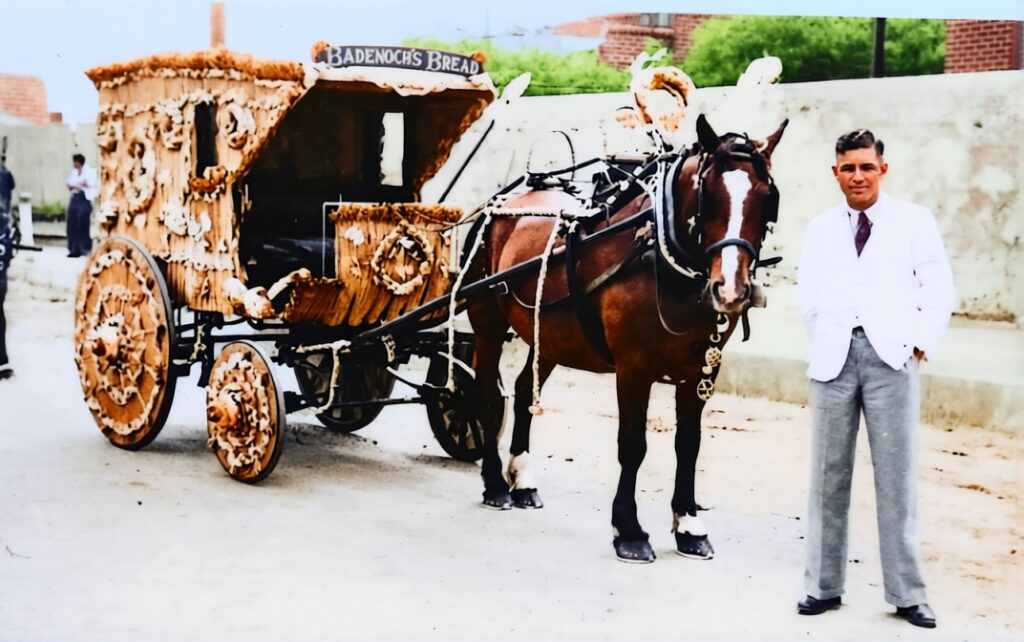 Badenoch’s Bakery Cart and Horse, Henley Beach Carnival with Ernie Lanyon c. 1941
(Box 1-108 – Henley & Grange Historical Society Collection – edited and colourised by AI)
In later years, Ernie Fielder’s truck became a regular feature of the Badenoch’s Carnival procession entry. Loaded with a piano, it carried Mal and Bob Badenoch and a troupe of local musicians, all sporting bakers’ caps, playing popular songs of the time as they travelled through the streets, delighting spectators along the route.
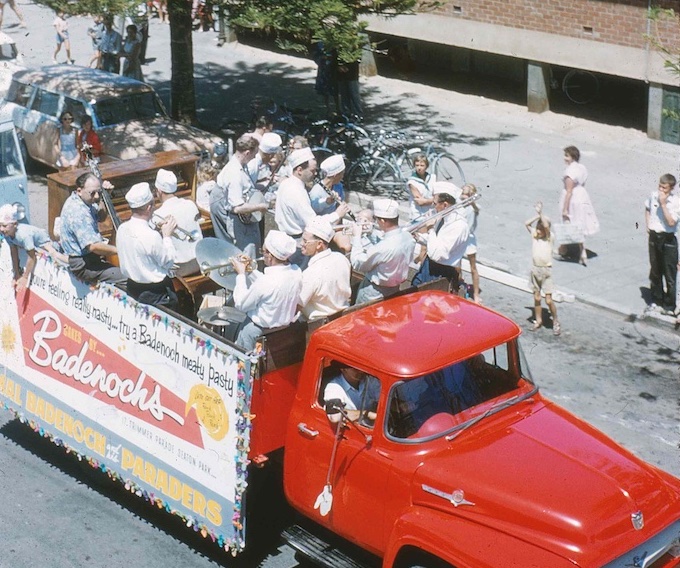 Badenoch’s Bakery Float in the 1960 Henley Beach Carnival
(Courtesy of the Stafford Collection – donated to Henley & Grange Historical Society)
Bob Badenoch talking in 1982 about being in the Henley & Grange Carnivals (1m 20s)
[Original recording edited and remastered using AI]
Research Sources:
Henley & Grange Historical Society, Journal 3, 1982, p.7-9
Badenoch’s Bread Cart at the Henley Carnival 1941 (HG 574 PH – Henley & Grange Historical Society Collection)
Badenoch’s Bread Cart at the Henley Carnival 1960 (Stafford Collection – donated to the Henley & Grange Historical Society)
Brief History of the Badenoch Company (HG CB 2 VF – Henley & Grange Historical Society Collection)
The history of W.R. (Bob) Badenoch & Sons, a successful Henley Beach Bakery business since 1917 (HG 0782ab AU- Henley & Grange Historical Society Collection)
DISASTER AND RATIONALISATION
In 1947, disaster struck.
Badenoch’s Henley Beach bakery was totally destroyed by fire on Tuesday 25th March 1947 at about 1.30pm. It caused damage to the value £3,000 which is about $255,000 today.
The following is an edited extract of an article appearing in ‘The News’ March 25, 1947, p. 1
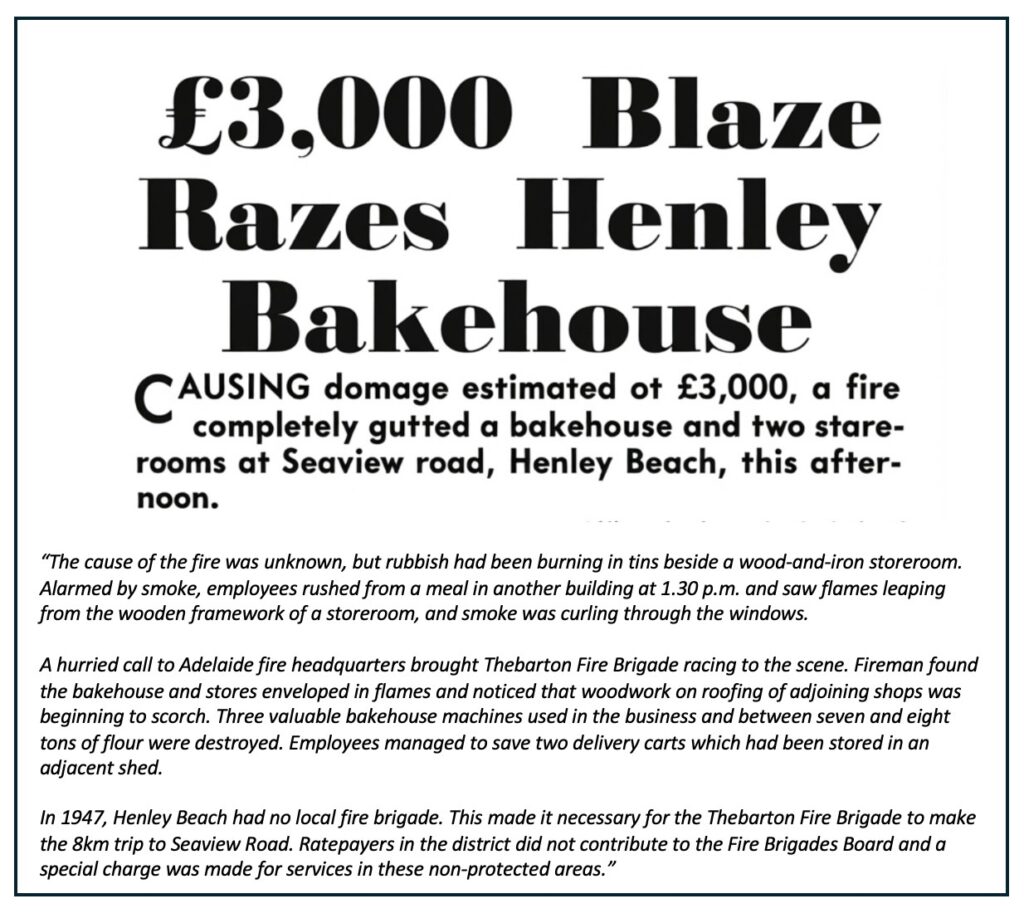 £3,000 Blaze Razes Henley Bakehouse
(Original article courtesy of ‘The News’ March 25, 1947, p. 1)
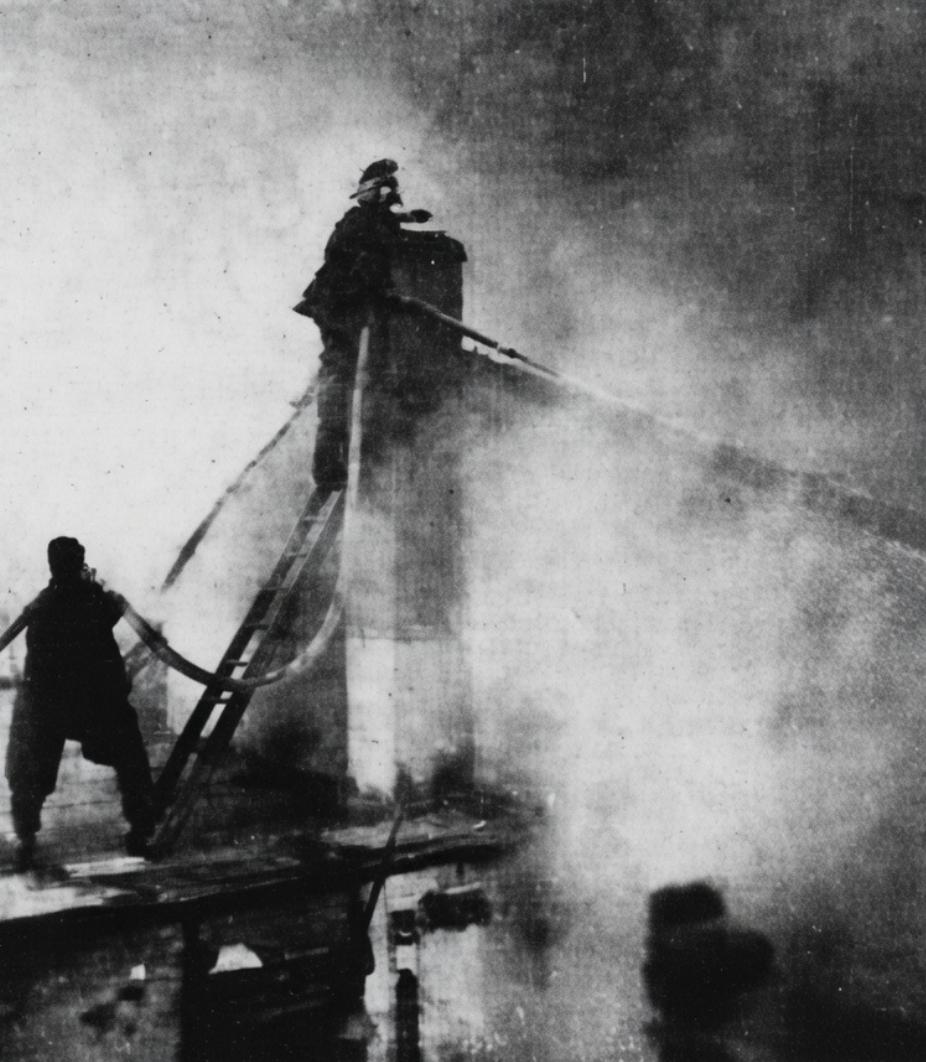 Photo taken shortly after the outbreak of fire at the bakery
(Photo courtesy of ‘The News’ March 25, 1947, p. 3)
(restored by AI)
The bakery and grocery store was re-built, and the wood-fired ovens were replaced by oil-fired ovens, but these were not extensively used from 1947 – 1950 as the business was diversifying, with bread making now occurring from the Trimmer Road premises of the Associated Baking Corporation of SA in Seaton and a cake and smallgoods manufacturing side from Holbrooks Road in Underdale.
Bread and smallgoods were delivered to the Henley Beach store from the new businesses until it was finally sold in 1954.
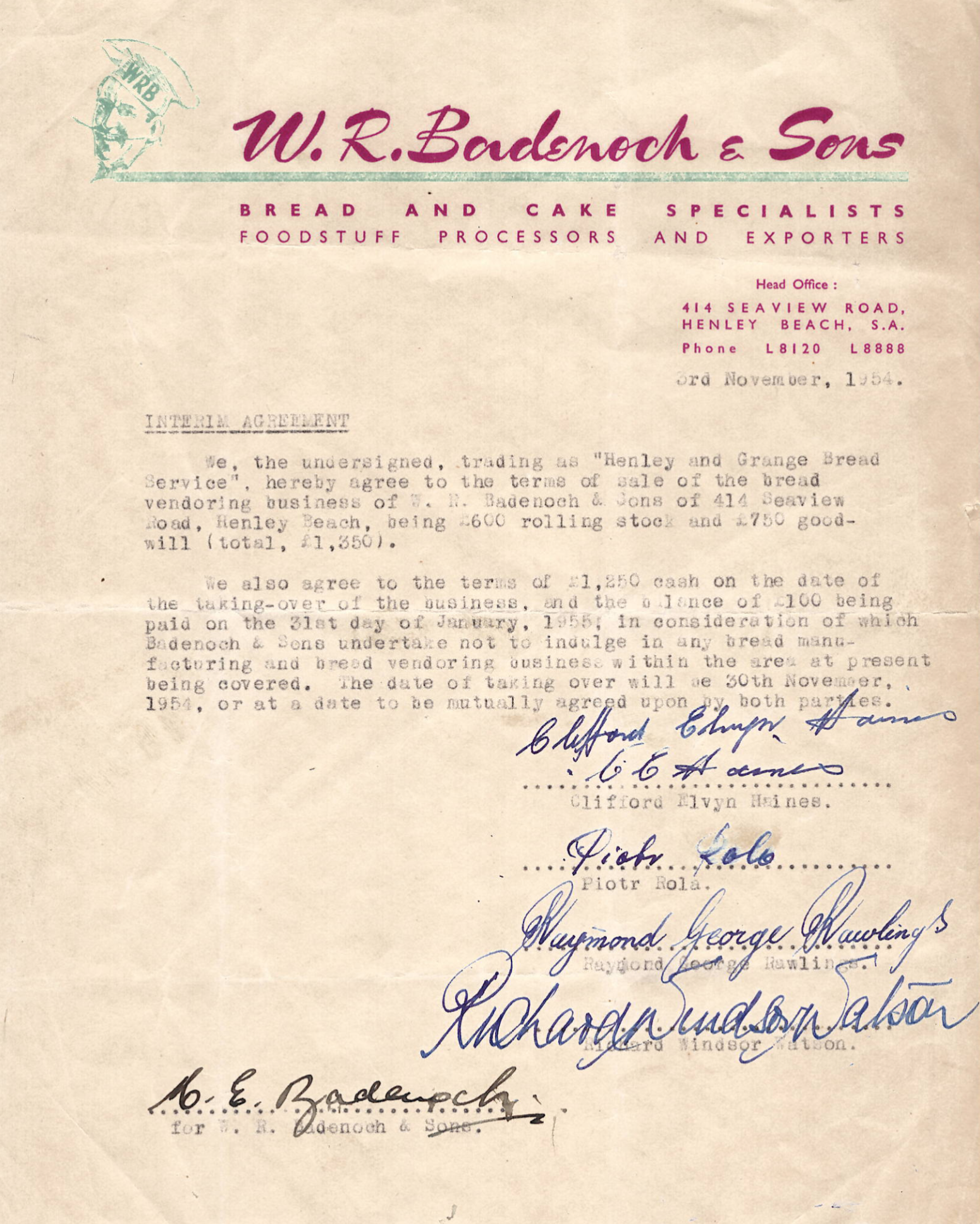
Interim agreement letter on the sale of Badenoch’s Henley Beach Bakery (3/11/1954)
(HG CB 2 VF – Henley & Grange Historical Society Collection)
Research Sources:
Henley & Grange Historical Society, Journal 3, 1982, p.7-9
National Library of Australia (https://trove.nla.gov.au/newspaper/article/127076020, http://nla.gov.au/nla.news-article127075993)
Brief History of the Badenoch Company (HG CB 2 VF – Henley & Grange Historical Society Collection)
WHO REMEMBERS PROCERA BREAD?
Procera (pronounced Pro-cera) was a special type of bread licenced to be baked by Badenoch’s at Henley Beach.
The Procera bread baking process involved enriching the flour with gluten, to boost its protein content, decrease starch and improve texture. It originated in New Zealand in the 1930s and was patented world-wide. One baker in each local market was granted the right to use the Procera name and the process in return for paying a royalty of 0.1 pence (or 0.1 cent) per loaf, in what became the first major franchising operation in Australia.
There were different varieties of Procera – white, wholemeal, slimming, and diabetic bread.
The regulation of starch and protein content of the loaf made it lighter and more easily digestible which was particularly noticeable when it is toasted. The Procera 100 per cent wholemeal loaf enjoyed great popularity with people who demanded wholemeal bread. The Procera Slimming and Diabetic loaves satisfied a craving for those with an eating desire for fresh bread. If a person on a diet used Procera slimming bread in place of ordinary bread they easily and pleasantly reduced their starch intake.
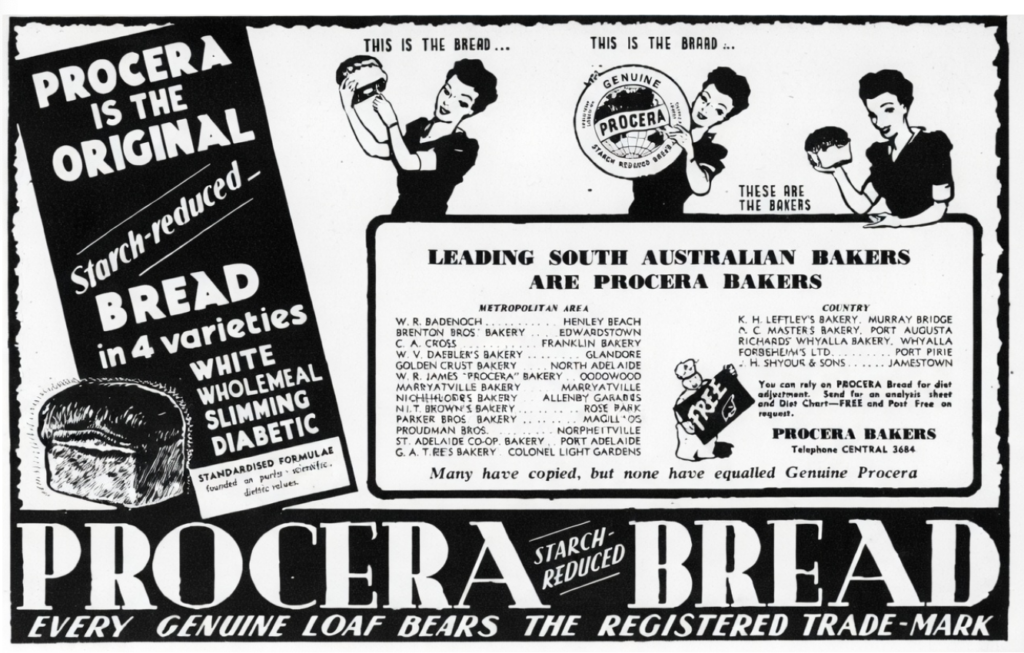 Procera Bread Advertisement
(Courtesy of The Advertiser, Wednesday 24 July 1946, page 6)
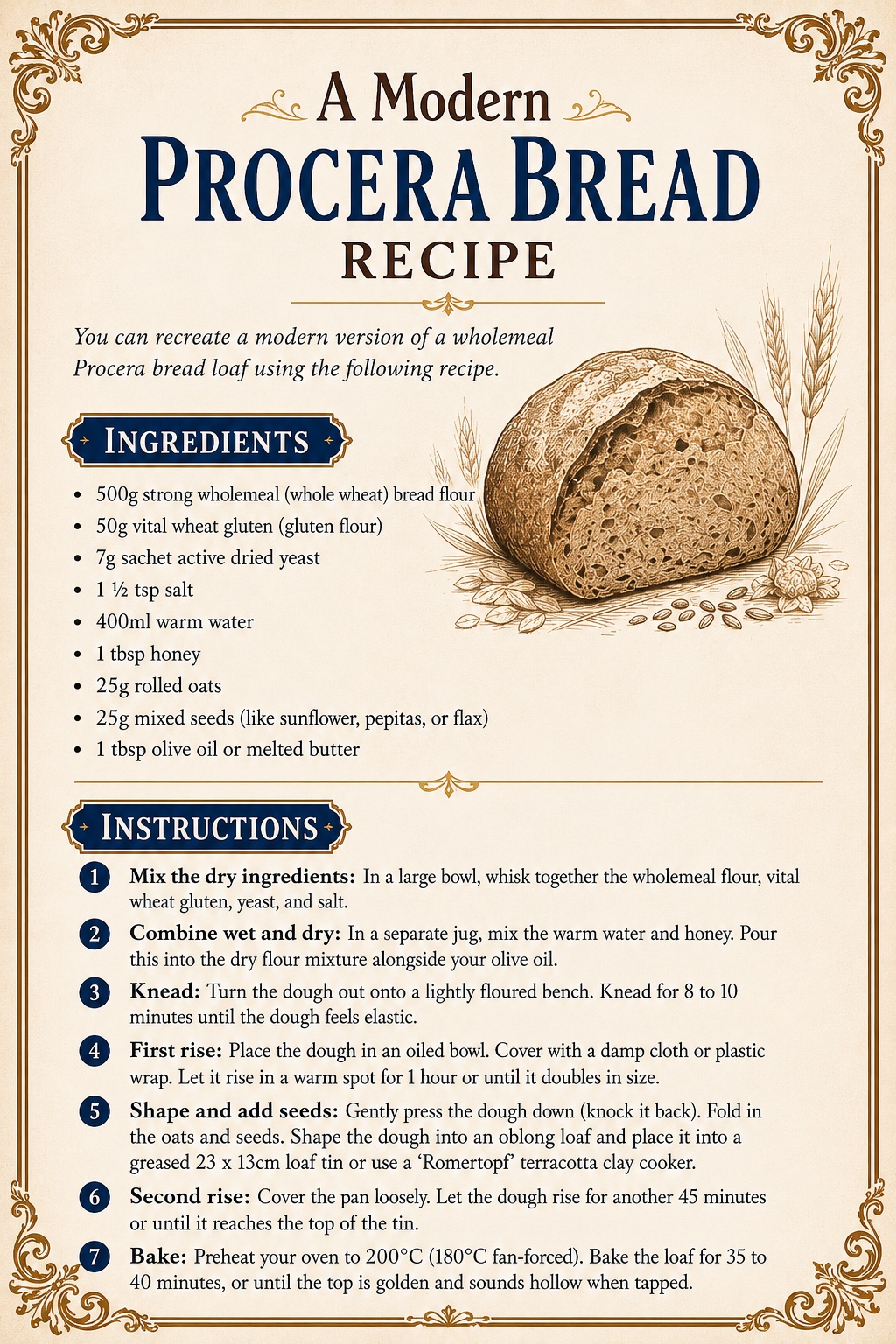
NOTES:
- The recipe above is a modern reconstruction (generated by AI) to approximate the characteristics of the original Procera wholemeal bread based on historical descriptions, the use of gluten flour to reduce starch and wholemeal bread-making practices. (Editor)
- CAUTION: Any person with Celiac Disease (Gluten intolerance) should not consume bread made using this recipe.
Research Sources:
National Library of Australia https://trove.nla.gov.au/newspaper/article/58855076
National Library of Australia https://trove.nla.gov.au/newspaper/page/7314226
National Library of Australia https://trove.nla.gov.au/newspaper/article/54787019
EXTRAS
 |
|
Original remains of a brown paper bag from Badenoch’s Bakery
|
 |
 |
|
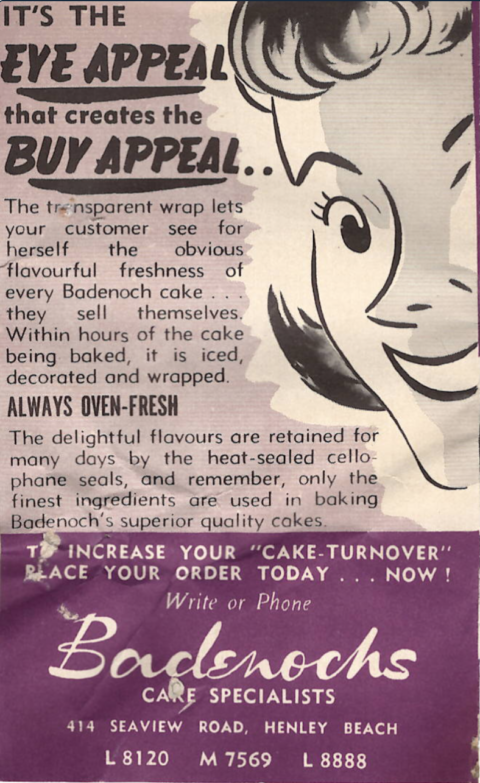
| Badenoch’s cake advertisement (HG CB 2 VF – Henley & Grange Historical Society Collection) |
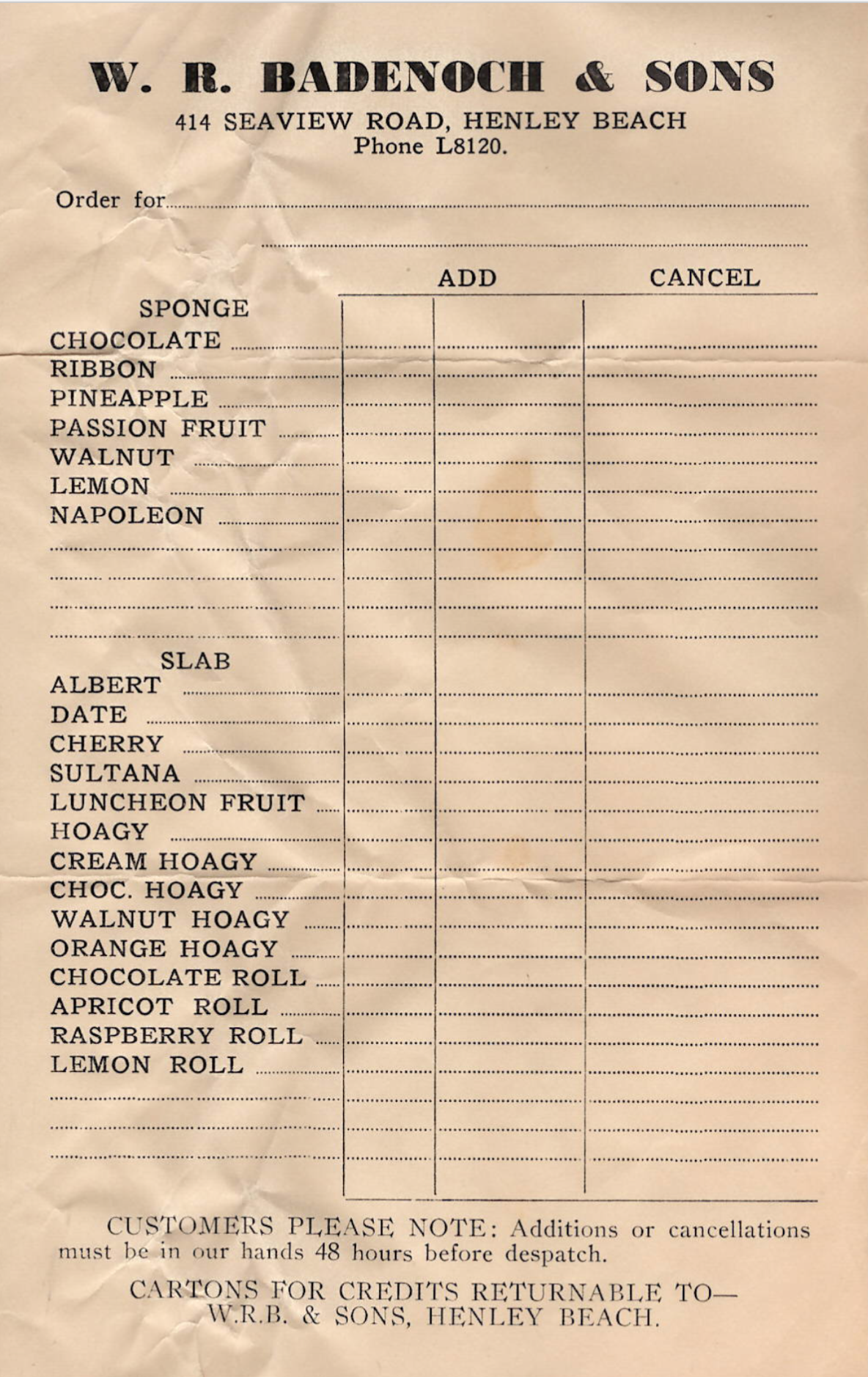
W. R. Badenoch & Sons Order form (HG CB 2 VF -Henley & Grange Historical Society Collection) |
Notes:
Generative Artificial Intelligence has been used to assist in refining the narrative of this article by improving flow and grouping related details without altering the factual integrity of the research. Some images (where appropriate) have been restored and colourised by AI tools to improve clarity. Audio originally recorded on cassette tapes in 1982 has been digitised and enhanced by an AI-powered audio editing app to edit out background noise and long silences.
Researched and edited by:
Roger Edmonds (H&GHS Committee)
June, 2026
0 Comments